WQE Prefetch
Overview
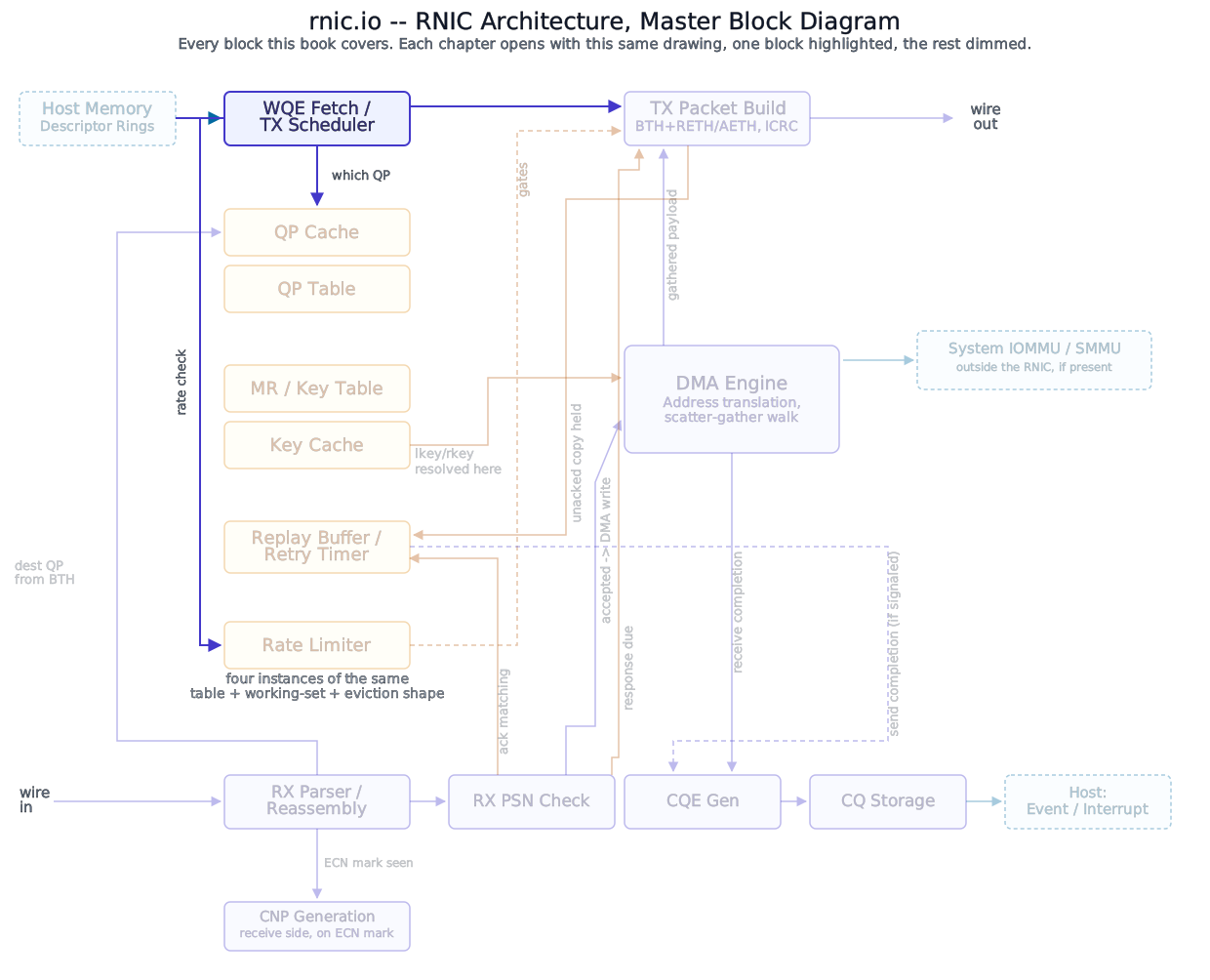
Fetching a WQE from host DRAM on every single doorbell would put a PCIe round trip on the critical path of every operation, the same problem QP Caching and Key Caching both solve for their own resources – but a Send Queue ring’s strict, front-to-back consumption order means the adapter doesn’t need to guess which WQE might be needed next the way a demand-driven cache does; it can simply read ahead of the consumer index before the pipeline actually asks. At least one shipped RNIC does exactly this: a dedicated on-chip WQE cache holding prefetched send WQEs, distinct from the QP-context and address-translation caches this book has already covered.
Locator
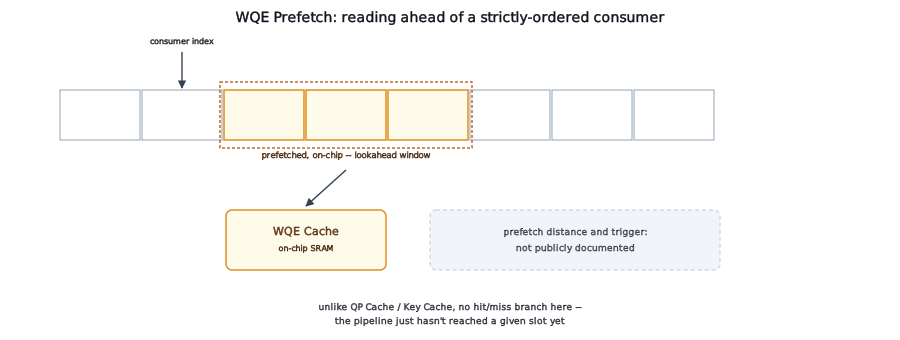
QP Caching and Key Caching both cover a demand-driven working set: a key or QP number arrives, possibly out of order, and the cache either holds it or doesn’t. A Send Queue ring has no equivalent of “an arbitrary index arrives” – it’s consumed strictly in order, one WQE after the next, which is exactly why this chapter’s structure is shaped differently from both of them.
Block diagram
Deep walkthrough
What actually exists – a direct citation, not an inference from the caching pattern elsewhere in this book. Kong et al. (NSDI 2023), describing a real RNIC’s on-chip microarchitecture resources directly, name a WQE Cache alongside the QP-context cache and the MTT/MPT cache this book already covers, with a plain description of its job: “the Work Queue Entry (WQE) cache stores prefetched send WQEs and posted receive WQEs.” This is the load-bearing fact for this chapter: at least one shipped RNIC does maintain a distinct on-chip structure specifically for WQEs read ahead of need, not a mechanism this book is inferring by analogy from the QP/key caching chapters.
Where this is checked, and the honest limit of what’s public. The same paper does not give the WQE cache its own capacity figure – it names the structure’s existence and its job, not its size. This book’s Queue Pair Management and Memory Region / Key Table caching chapters don’t have a citable SRAM-size figure of their own to compare it against either: both are explicit that no source pins down an exact QPC byte size or a separate MTT/MPT capacity number, so there’s no established total this chapter can measure the WQE cache’s share against. It also doesn’t state how many WQEs ahead of the consumer index get prefetched, or what triggers a prefetch (a fixed lookahead distance, decided once at design time, versus something adaptive to how quickly the pipeline is actually consuming). [SPARSE PUBLIC SOURCING beyond the one sentence above] – neither the uRDMA paper nor the QP-scaling loss-recovery paper this book cites elsewhere mentions WQE prefetching at all, checked directly rather than assumed. This chapter names the real anchor plainly and doesn’t invent the specifics no source confirms.
Why this isn’t a hit/miss structure the way QP Cache and Key Cache are. Both of this book’s earlier caching chapters describe a genuine miss path: a key or QP number the cache doesn’t currently hold, requiring a fallback fetch and a measurable penalty. A WQE prefetch buffer’s failure mode is different in kind – there is no “wrong” WQE to look up, because the pipeline only ever wants the next one in strict ring order. What can actually go wrong here is a prefetch that hasn’t caught up: the pipeline reaches the consumer index faster than the prefetch mechanism has read ahead, and the next WQE simply isn’t on-chip yet when it’s needed. That’s a real stall, not a cache miss in the QP-Cache/Key-Cache sense – and Single-QP Pipeline Stalls is where this chapter’s failure mode actually gets treated in depth, rather than re-deriving it here.
Concept
A WQE prefetch buffer has no “wrong” entry to look up and therefore no miss in the QP-Cache/Key-Cache sense – its only failure mode is a prefetch that hasn’t caught up to the consumer index yet, a stall, not a miss.
What this argument doesn’t cover: many QPs sharing one prefetch buffer. Everything above reasons about a single QP’s own ring in isolation – true within that scope, but not the realistic case. Key Caching already found real evidence (the uRDMA paper) of one shared, unpartitioned SRAM pool covering QPC/MTT/MPT/CQC/EQC together – though that same chapter is explicit that Kong et al., this chapter’s own cited source for the WQE cache, actually names the WQE cache as a structure distinct from that pool rather than confirming it’s part of the same one, an ambiguity neither source resolves. Whichever way that turns out, a pipeline servicing many concurrently-active QPs at once (exactly what Multi-QP TX Scheduling is about two chapters from now) has to divide finite prefetch capacity across all of them, and nothing here says whether one QP’s aggressive lookahead can starve another QP’s prefetch entirely – the same head-of-line-blocking shape Single-QP Pipeline Stalls spends a full chapter on for the scheduling gate. This chapter’s “no eviction policy to design” conclusion holds only for one QP’s own ring; whether the shared buffer needs an allocation policy across QPs is an open question this chapter doesn’t answer.
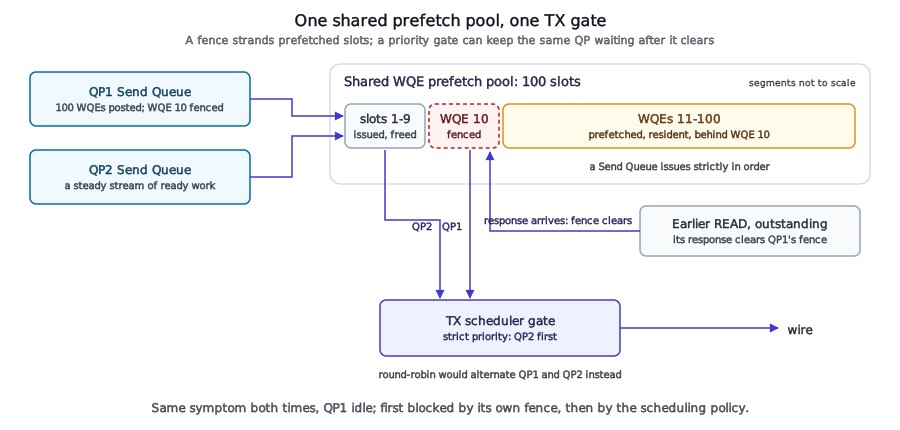
A concrete shape of the problem, with actual numbers. Say the shared pool holds 100 slots total, and QP1 arrives first with 100 Work Requests posted, the tenth one fenced. Since the pool is empty when QP1 shows up, a scheduler with no other allocation policy grants it all 100 slots at once. WQEs 1 through 9 issue and free their slots immediately; WQE 10 blocks on its fence, and because a Send Queue issues strictly in order, WQEs 11 through 100 are stuck behind it – prefetched, resident, and completely unusable, holding 90 slots that are doing nothing. QP2 arrives next, wanting slots of its own, and finds only the 9 QP1 already freed. Nobody did anything wrong – QP1’s fence is legitimate, QP2’s request is legitimate – the problem is entirely in how the shared pool got allocated in the first place.
Play it, and the gate that keeps QP1 waiting even after its fence clears:
All 9 steps
- The prefetch pool. QP1 posts 100 Work Requests. The tenth is fenced: it may not start until an earlier READ, still outstanding, has its response. WQE Prefetch
- The pool is empty and nothing limits one QP’s share, so QP1 is granted all 100 slots and its WQEs are prefetched on-chip. WQE Prefetch
- WQEs 1 to 9 issue through the gate and leave on the wire, freeing their slots as they go. Multi-QP TX Scheduling
- No. A Send Queue issues strictly in order, so everything behind WQE 10 waits with it: 90 slots resident, prefetched, and doing nothing. Single-QP Pipeline Stalls
- QP2 arrives with work of its own and finds only the 9 slots QP1 freed. Nobody did anything wrong: the fence is legitimate, the request is legitimate, and the problem is how the pool was handed out. WQE Prefetch
- At the gate. The gate favours QP2 and QP2 always has something ready, so QP2 is serviced every turn. Unremarkable so far: QP1 has nothing eligible to offer. Multi-QP TX Scheduling
- The earlier READ’s response arrives and QP1’s fence clears. WQE 10 and the 90 behind it are eligible again. Single-QP Pipeline Stalls
- Not under strict priority. QP2 is still ready and still favoured, so it wins every turn and QP1 stays idle. Same symptom as before, different cause: the fence explained QP1’s wait before, the policy explains it now. Multi-QP TX Scheduling
- The gate is round-robin instead: Round-robin does not share this failure: QP1 gets the next turn and resumes, and QP2 is served on the turn after. Multi-QP TX Scheduling
Gotcha
Don’t reach for “eviction policy” to describe reclaiming a stalled QP’s held-but-unusable prefetch slots, even though the shape looks similar on the surface. Eviction Policy already claimed that name for a different problem: reclaiming a QP context from a hot, on-die cache back to slower backing storage once too many QPs are active at once to fit on-die. Both are about taking a resource away from something, but the structures and the cost of getting it wrong aren’t the same – worth two different names from the start rather than one word doing double duty.
Food for Thought
This chapter’s “no eviction policy to design” conclusion holds only for one QP’s own ring. A pipeline servicing many concurrently-active QPs has to divide finite prefetch capacity across all of them – does one QP’s aggressive lookahead starve another QP’s prefetch entirely, and if so, what would a fair allocation policy across QPs even look like here, given there’s no victim to select the way QP Cache and Key Cache have one?
What happens next. Once a WQE is on-chip – prefetched ahead of need, or fetched just-in-time if the prefetch hasn’t caught up – it’s ready for the stage that actually turns it into wire bytes: TX Packet Build, covered next.
Why
A demand-driven cache and a lookahead prefetch buffer are both answers to the same underlying question – how to avoid paying a PCIe round trip on every single operation – but they’re the right answer to different access patterns. QP numbers and keys arrive in whatever order a workload’s traffic happens to produce, which is exactly why QP Caching and Key Caching need real eviction policies deciding what to keep resident under pressure. A Send Queue’s WQEs never arrive out of order relative to their own ring – the next one needed is always, by construction, the next one in the ring – so for one QP’s own prefetch there’s no victim to select; the design question within that scope is how far ahead to read, a tuning parameter rather than a policy question. Across QPs sharing the same buffer, that scoping stops holding, and this chapter has already flagged what it can’t answer there. Building a WQE prefetch buffer as a lookahead structure rather than forcing it through the same hit/miss/eviction framing as this book’s other caches isn’t a missed opportunity for consistency – it’s matching the mechanism to an access pattern that’s structurally simpler than the ones QP Cache and Key Cache actually have to handle.
TX Packet Build is next: the stage that takes an on-chip WQE and actually produces the wire packet What Is RoCEv2 already described field by field.
References
- No IETF or IBTA standard governs WQE prefetch buffer sizing, depth, or trigger mechanics – it is implementation-specific silicon design, not a wire-format or software-interface contract any standards body defines. This chapter’s treatment is grounded in the sources cited in-text above, not a standards document.