Mid-Transaction TX Reset
Overview
RESET is legal from any state, including RTS with a WQE actively occupying one of this part’s own pipeline stages. What has to become of that WQE – does the build it’s partway through complete, get aborted, or land in some undefined state – is exactly the kind of question Mid-Transaction QP Reset already flagged as underdocumented for the QP’s other in-flight state. This chapter isn’t limited to that same reasoned-analysis-only territory, though: engineers who worked on software support for a named, shipped RNIC are on record describing it as unable to do this cleanly in hardware at all.
Locator
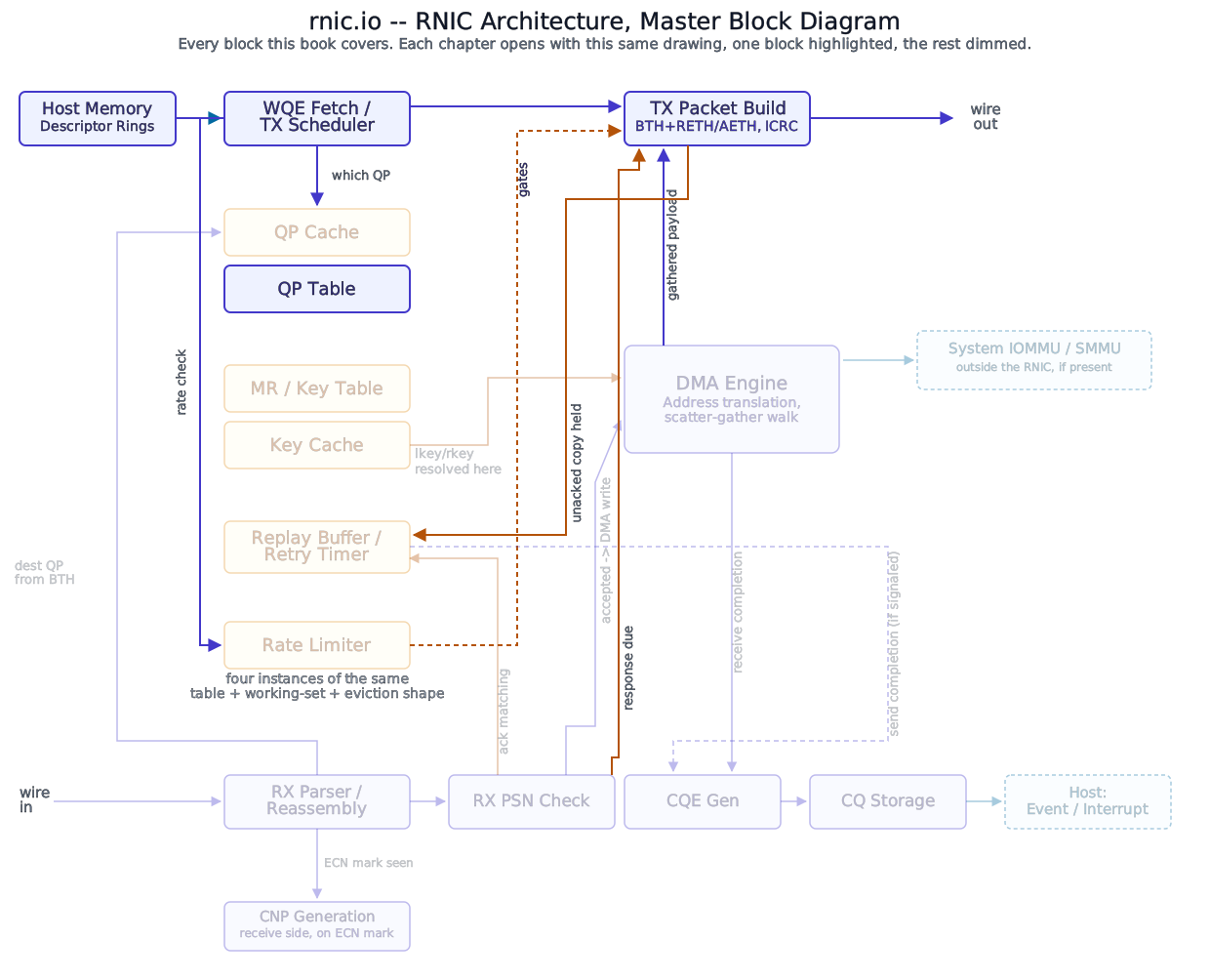
Mid-Transaction QP Reset closed Queue Pair Management on a resource torn down while something was still actively using it – a replay-buffer entry, a partially-reassembled message, a DMA write mid-burst. This chapter closes TX Pipeline on the same shape of question, asked specifically of everything this part just built: a WQE mid-fetch, mid-prefetch-buffer-residency, mid-build, or mid-schedule, at the exact instant its owning QP’s state machine takes a RESET transition.
Block diagram
Deep walkthrough
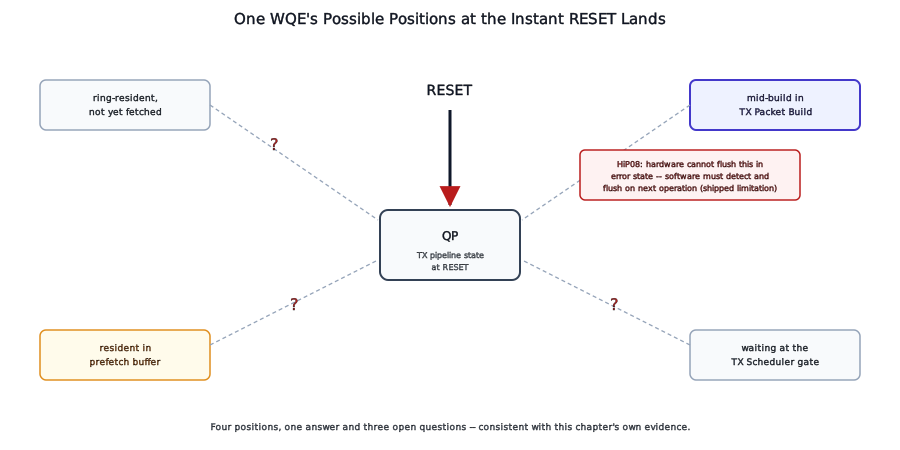
What actually exists to reconcile, specific to this part. By the time RESET can land on a QP with traffic in flight, this part has established at least four places a WQE might be sitting: still in the ring, untouched (The Send Queue Ring); resident in the on-chip prefetch buffer, read ahead of need but not yet processed (WQE Prefetch); partway through header assembly (TX Packet Build); or queued at the scheduling gate, fetched and ready but waiting its turn behind other QPs’ traffic (Multi-QP TX Scheduling). RESET’s job is to leave none of these positions holding state that corrupts whatever gets built or scheduled next – but the specific sequencing that gets there for each of the four isn’t something any public source for a real RNIC documents in general.
A named, shipped exception to “no public source documents this.” A Linux kernel patch for Huawei’s HiP08 RoCE hardware (the RDMA/hns driver) states plainly, in its own commit description, that the hardware itself “lacks ability to flush outstanding WQEs if QP state gets into errored mode.” This is not this book’s reasoned speculation about a hard problem – it’s a real, named, shipped-silicon admission from the people who had to build software around it: the hardware itself cannot cleanly flush a QP’s outstanding work purely in response to an error/reset transition. The documented workaround is entirely software-side: detect the errored QP state during whatever operation happens to touch it next (a subsequent post-send, post-receive, or completion poll) and perform the flush from software at that point, deferred through a workqueue rather than run immediately to avoid doing that work while holding a lock protecting other pipeline state. This is directly relevant to this chapter’s own open question: at least one real vendor’s answer to “what happens to outstanding TX-side work on reset” is, in effect, hardware doesn’t fully answer it, software has to notice and clean up afterward – a different answer than “hardware handles it,” and a citable one.
A related, documented spec-vs-implementation dispute, named precisely rather than laundered into vague language. IBTA-V1 (§10.2.4.4) names a related but distinct scenario: it’s good programming practice to move a QP to ERROR and retrieve its CQEs before destroying that QP, since destruction alone doesn’t guarantee the QP’s CQEs get deallocated from a Completion Queue. That’s a recommendation for QP teardown, not a hardware-enforced precondition on the RESET transition this chapter is actually about – a QP being reset for reuse is a different act from a QP being destroyed outright, and IBTA doesn’t gate this chapter’s RESET-for-reuse case behind a mandatory drain step. A real, archived linux-rdma mailing-list thread shows this isn’t purely academic: Tom Talpey disputed another engineer’s claim that moving a QP to RESET clears its associated completion queues outright, pointing out that IBTA’s own text keeps work queues and completion queues separate and that CQs are routinely shared across QPs – “erasing entries from them is disastrous to the other QPs.” Bob Pearson, investigating the dispute, found that Mellanox’s mlx5 driver does exactly this via its own mlx5_ib_cq_clean() routine, which Talpey characterized as a bug rather than a correct reading of the spec. This is a real, documented spec/implementation tension – but it’s precisely about Completion Queue cleanup during QP destruction, which is Completion Queue / Event Management’s territory, not this part’s WQE-side state during a RESET-for-reuse. Named here as an adjacent data point and a forward-pointer, not claimed as direct evidence about the TX pipeline’s own four positions above.
Where this leaves the reader. One of this chapter’s four open positions – mid-build – has a shipped, named answer, and it’s an admission of a hardware gap rather than a documented guarantee. The other three – ring-resident, prefetch-buffer-resident, and scheduler-queued – remain exactly as underdocumented as Mid-Transaction QP Reset found its own five satellite structures to be. This chapter doesn’t manufacture answers for the three it can’t source, and doesn’t let the one answer it found imply the other three are equally well understood.
Why
The HiP08 case above is more than a trivia item: it’s evidence for which side of a genuine design tradeoff at least one real vendor landed on. Building hardware that can cleanly abort a WQE at any of this part’s four pipeline positions, at any instant, is substantial silicon complexity – every stage needs an abort path, not just a forward path, and that path has to be provably correct for a case (an error transition) that is by definition rare and hard to test exhaustively. Punting that complexity to software – let the hardware simply stop being coherent about outstanding work on error, and have software notice and clean up on the next touch – is cheaper to build and verify, at the cost of a window where outstanding state is inconsistent until software happens to look. HiP08’s own documented history shows a vendor accepting that cost, at least for one hardware generation, rather than building the harder, fully-hardware-flushable alternative.
Food for Thought
HiP08 shows one vendor’s engineering documentation admitting hardware can’t flush outstanding work in error state, punting the problem to software instead. Did other vendors make the opposite trade and build a fully hardware-flushable pipeline? What would you actually check on real hardware to find out, given the public record doesn’t say either way?
Every chapter so far has followed a packet this QP’s own software asked for. Response Generation closes this part with the packets it never asked for: the acknowledgments and READ responses a responder owes.
References
- InfiniBand Trade Association, InfiniBand™ Architecture Specification, Volume 1 (General Specifications) – IBTA-V1 §10.2.4.4 recommends the ERROR-then-drain-CQEs practice named above, for QP destruction specifically, not as a precondition on the RESET transition this chapter covers.
- Linux kernel
RDMA/hnsdriver patch, “RDMA/hns: Support flush cqe for hip08 in kernel space” (patchwork.kernel.org/project/linux-rdma/patch/1532002981-7175-1-git-send-email-liuyixian@huawei.com/) – source for the HiP08 “lacks ability to flush outstanding WQEs if QP state gets into errored mode” quote and the workqueue-deferred software workaround described above. linux-rdmamailing list thread, “QP reset question” (spinics.net/lists/linux-rdma/msg101140.html) – Tom Talpey, Dotan, and Bob Pearson’s archived exchange, source for the mlx5mlx5_ib_cq_clean()CQ-cleanup dispute named above.- No IETF or IBTA standard governs whether a specific RNIC’s hardware can flush outstanding TX-side work on an error/reset transition for the other three positions (ring-resident, prefetch-buffer-resident, scheduler-queued) – that remains implementation-specific silicon design with no public source this book found.