Transparent by Default
Address Translation Handoff named the output of a Key Cache lookup a physical address and moved on, the same term Key Caching and MR Capacity and Timing both already used. That term is correct as far as those chapters’ own scope reaches. This chapter is about what’s true one layer further out.
Overview
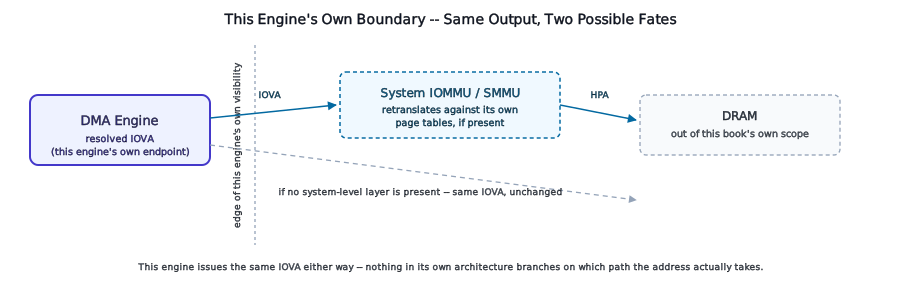
The address Address Translation Handoff resolves is this engine’s own endpoint, not necessarily the last translation a byte passes through before it reaches a DRAM row. In any virtualized, SR-IOV, or PCIe-passthrough deployment, a system-level IOMMU or SMMU sits on the path between this engine and real memory, and retranslates that address again – transparently, by default, with this engine’s own hardware carrying no architectural awareness that the retranslation is even happening.
Concept
Call the address this engine’s own Key Cache resolves to an IOVA – an I/O virtual address, standard terminology for exactly this layer – rather than assuming “physical” always means “final.” This engine’s own architecture never had to distinguish the two before this chapter; every prior chapter’s use of “physical address” stays accurate for what it was describing, just scoped one layer short of the whole path.
Locator
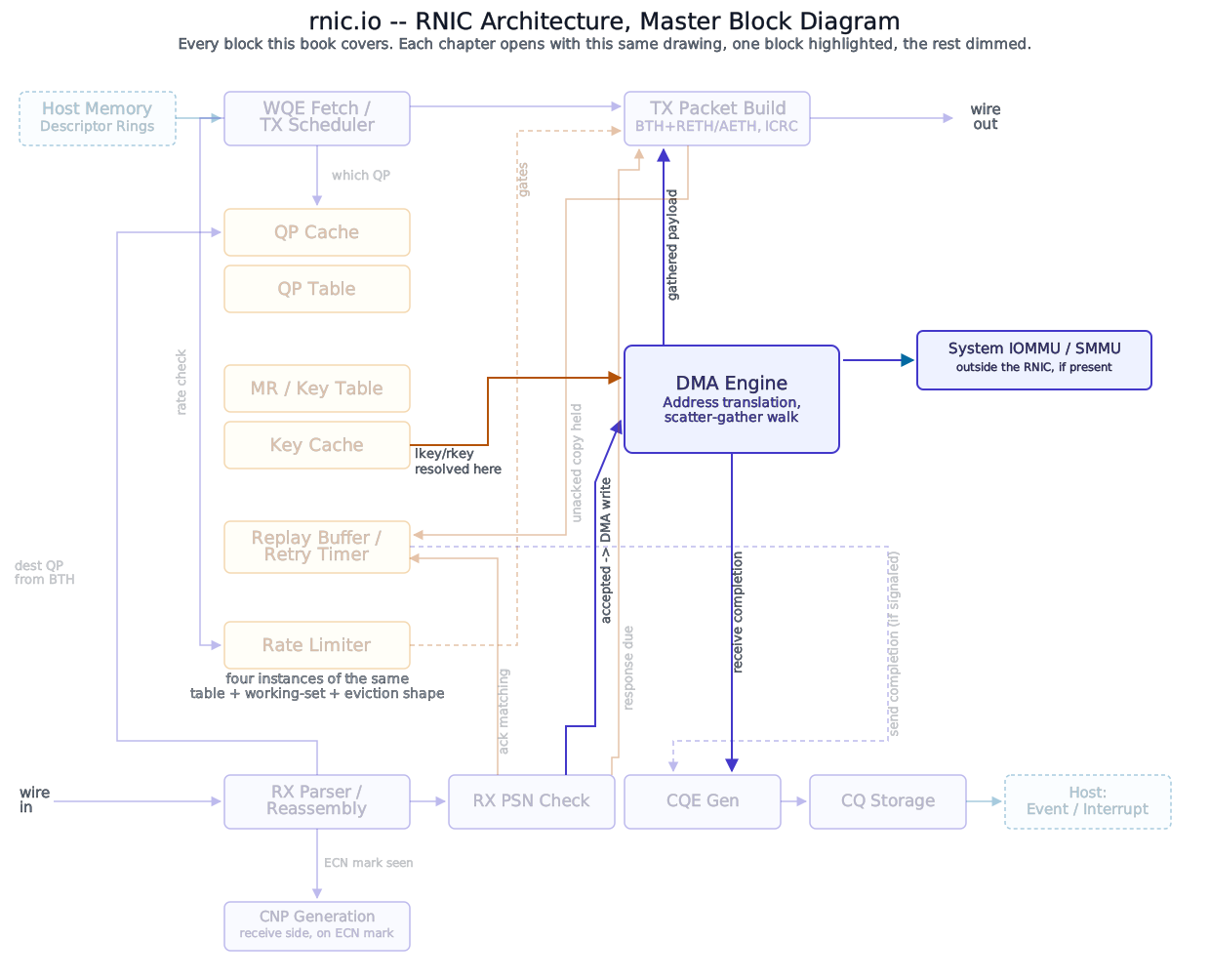
System IOMMU / SMMU is drawn the same way Host Memory Descriptor Rings and Host: Event/Interrupt already are – external, dashed border, something outside the RNIC this engine’s own pipeline directly touches. Unlike those two, it isn’t guaranteed to exist in every deployment at all.
Block diagram
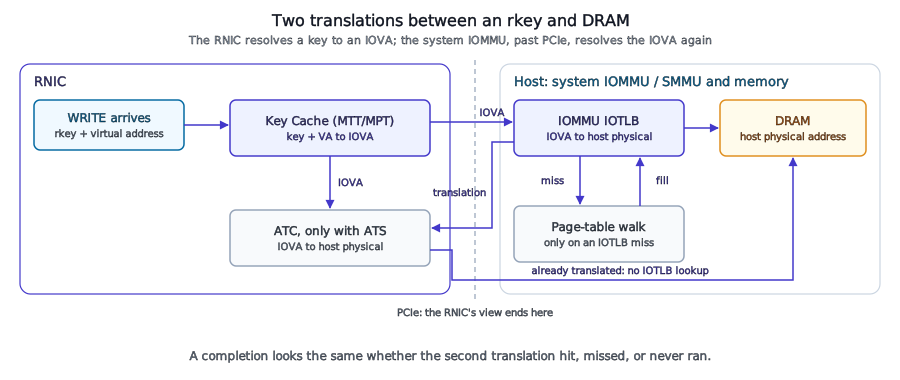
All 11 steps
- Two layers, by default. A WRITE arrives carrying an rkey and a virtual address the remote side chose. Target Selection
- The Key Cache checks the rkey’s permission and bounds and translates the virtual address. The RNIC’s own result is an IOVA, which it treats as the final address. Key Caching
- The write leaves the RNIC across PCIe with that IOVA. Nothing in the RNIC changes whether a system IOMMU is present. Transparent by Default
- The IOMMU’s IOTLB holds this page, so the IOVA becomes a host physical address and the write lands in DRAM. With passthrough guests, this second check is what keeps one tenant out of another’s memory. Transparent by Default
- An IOTLB miss. A second WRITE targets a page the IOTLB doesn’t hold. The Key Cache translates it as before; the miss happens past PCIe. IOTLB Misses and the Latency This Engine Can't See
- The IOMMU walks its own page tables. Tiemann et al. (2022) measured about 330 ns added per IOTLB miss on their platform. IOTLB Misses and the Latency This Engine Can't See
- The walk fills the IOTLB and the write goes on to DRAM. IOTLB Misses and the Latency This Engine Can't See
- Nothing. There is no error and no signal; the completion looks the same as for a hit. The RNIC only sees its own DMA slot staying busy longer. IOTLB Misses and the Latency This Engine Can't See
- With ATS. A device that supports ATS asks the IOMMU for a translation explicitly and keeps the answer in its own Address Translation Cache. No source this book found confirms shipped RNICs do this. ATS: Caching a Translation Locally
- Later writes to that page look up the IOVA in the ATC instead of sending it across. ATS: Caching a Translation Locally
- The RNIC issues the already-translated address and the IOTLB isn’t consulted. If the mapping changes, the IOMMU sends an Invalidate Request, and the device must answer with an Invalidate Completion only once the entry is actually cleared. ATS: Caching a Translation Locally
Deep walkthrough
Why this layer exists at all, from this engine’s own motivating angle. A generic “why does an SoC need an IOMMU” case is a different site’s territory. This book’s own version of that question is sharper, because RDMA’s whole model makes the answer more load-bearing than it is for most other DMA-capable devices: a WRITE lets a remote peer place data at an address this side’s software never chose at the moment the packet arrived, and Target Selection already established that mechanism in full. An RNIC whose virtual function is assigned directly to a guest – SR-IOV, PCIe passthrough – with no hypervisor mediating each individual operation, means a system-level IOMMU or SMMU’s enforcement is the only thing standing between that guest’s own RDMA traffic and a different tenant’s physical memory. This engine’s own Key Cache checks permission and bounds against what one QP’s software registered; it has no way to check, and no reason to check, whether that registration itself was scoped correctly by a hypervisor that trusts the guest less than the guest trusts itself.
Why
Every other DMA-capable device on a bus benefits from system-level isolation. An RNIC benefits from it more, specifically because The Operation Catalog’s own opcode set includes WRITE – an operation type most bus masters never have an equivalent of, where the device itself, not local software, decides the destination address for an arriving payload. That’s exactly the capability a compromised or misconfigured guest would want to abuse, and exactly the capability this layer exists to contain even when this engine’s own checks pass cleanly.
Transparent by default – this engine’s own architecture doesn’t change. Without any further mechanism, this engine issues the IOVA Address Translation Handoff resolved exactly the same way whether a system-level IOMMU or SMMU is present or not. The retranslation, when it happens, happens at the boundary between the PCIe fabric and the memory controller – outside this engine, outside the RNIC entirely – and nothing in this engine’s own execution model branches on whether that boundary exists. In-Flight Transfer State’s current-address field holds this engine’s own IOVA throughout a transfer’s execution; it was never holding a guaranteed-final physical address, even before this chapter named the distinction.
Gotcha
Don’t read this chapter as correcting an error in Address Translation Handoff, Key Caching, or MR Capacity and Timing. None of them claimed anything about a system-level translation layer, and “physical address” is the right term for what each of them was describing – this engine’s own resolved endpoint. This chapter adds a layer those chapters never claimed to reach, rather than fixing a mistake in them.
What “transparent” doesn’t mean: free. Transparency here describes this engine’s own architecture, not the cost of what’s happening underneath it. A retranslation that this engine has no way to observe can still take real time and can still fail – IOTLB Misses and the Latency This Engine Can’t See, immediately next, is what that actually costs. ATS: Caching a Translation Locally is the one real mechanism that trades this section’s default transparency for visibility, on request.
A resource this book’s own multi-instance question doesn’t reach. Multi-QP Burst Arbitration already covers contention for this engine’s own concurrent-transfer capacity. Whatever queueing or contention exists inside a system-level IOMMU or SMMU’s own translation hardware – shared, in a real deployment, across every device on the bus, not just this one RNIC – is a different resource this engine has no visibility into and this book doesn’t extend its own arbitration treatment to cover.
Interface reference
| Question | Answer |
|---|---|
| Is a system-level IOMMU/SMMU guaranteed to be present | no – deployment-dependent (virtualized, SR-IOV, or passthrough systems are the common case where one is) |
| What does this engine’s own resolved address represent precisely | an IOVA – this engine’s own translation’s endpoint, not necessarily the final DRAM address |
| Does this engine’s own architecture change based on whether one is present | no, by default – fully transparent, no awareness at either end of a transfer |
| What does transparency cost | nothing architecturally, but not nothing in latency – see IOTLB Misses and the Latency This Engine Can’t See |
| Is there a way to opt out of the transparency and see the translation | yes – ATS, on request |
References
- PCI-SIG, PCI Express Base Specification, Address Translation Services (ATS) extension (introduced PCIe 4.0) – governs the one opt-in mechanism, covered in ATS: Caching a Translation Locally, that changes this chapter’s default transparency.
- No IBTA or RoCEv2 standard governs system-level address translation at all – it is host/root-complex architecture, entirely outside RDMA’s own wire-level or QP-level scope. This chapter’s own claims are architectural reasoning about the RNIC-facing half of a boundary those standards never address, not a citation to either standard.