The QP Table
Overview
Every QP context described in the previous chapter lives somewhere: one entry in a table sized to hold as many QPs as the adapter supports, addressed by the QP number that came back when the QP was created. This chapter covers that table’s shape – how a QP number becomes an index, and why an indexed, page-table-like structure is the natural answer to a problem this book can otherwise document only thinly.
Locator
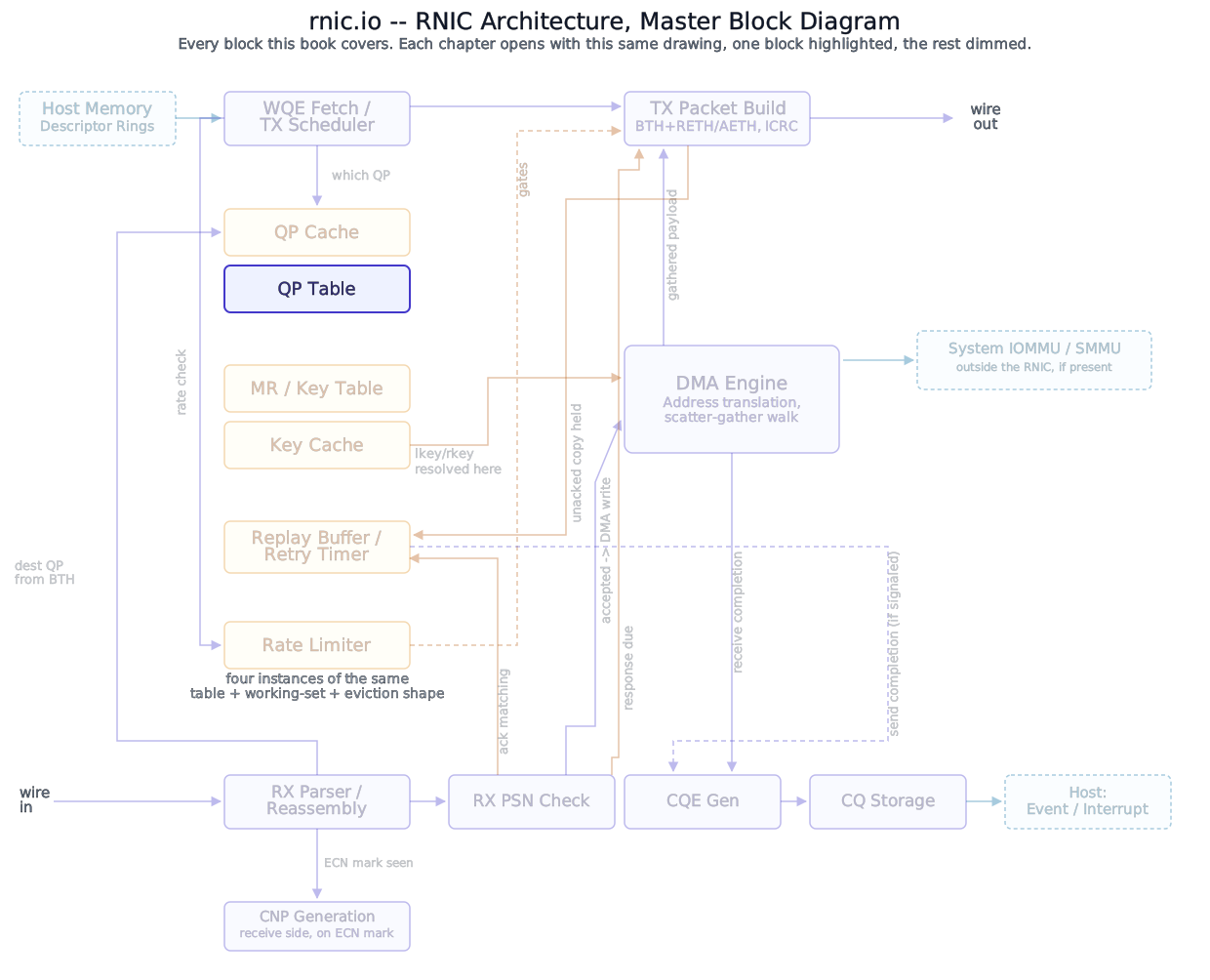
QP Context covered what’s inside one entry. This chapter is about the structure holding every entry, and how a QP number finds the right one.
Block diagram
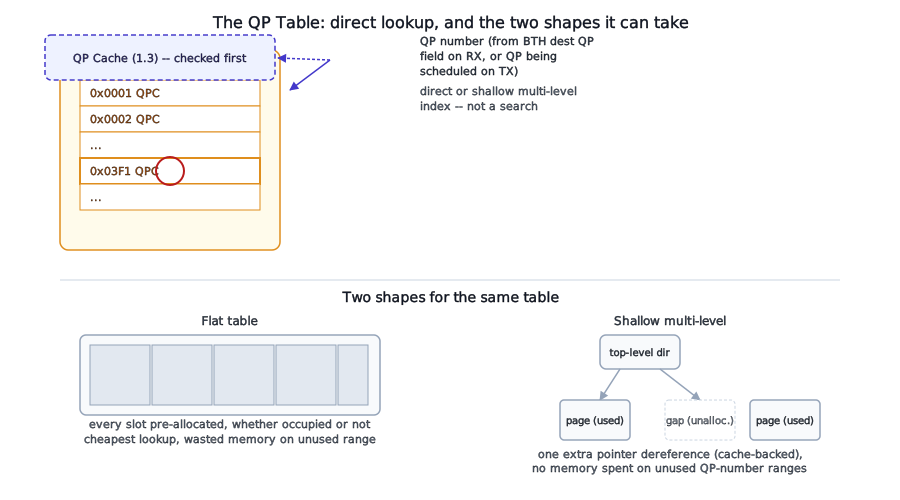
This chapter’s table diagram now carries two panels: the lookup path itself, and a second inset making the design-rationale sidebar’s flat-vs-multi-level tradeoff visible rather than leaving it only in prose.
Deep walkthrough
What the index actually is. A QP number is assigned once, when the QP is created, and held fixed for that QP’s entire life – it never gets reassigned to a different table entry while the QP exists. That’s what makes a QP number usable as a direct table index rather than a key that needs resolving: the adapter (or the driver, coordinating with the adapter’s own resource allocator) hands out QP numbers from a bounded range it manages itself, which means the numbers in active use are dense or near-dense within that range, not sparse values scattered across a huge address space. A dense, hardware-assigned index makes a flat, directly-indexed table the obvious structural fit. Once the range grows large enough that a single flat table would waste memory on entries nobody uses, a shallow multi-level table – walked the same way a page table is – becomes the better fit instead.
Analogy
Not that a QP table walk resembles a virtual-memory walk in its mechanics, but that both solve the same problem: a huge notional address space with a much smaller dense working subset, answered the same way – flat while it’s cheap, multi-level once it isn’t.
Where this gets checked. Two places ask this table the same question, from opposite ends of a connection: the TX side, resolving the QP number of whichever QP is about to be scheduled, and the RX side, resolving the destination QP number just read out of an arriving packet’s BTH (What Is RoCEv2). Neither lookup goes directly to this table in the common case – QP Caching, next, is the structure actually consulted first, with this table as the backing store a cache miss falls through to.
When a lookup doesn’t resolve. A QP number that doesn’t correspond to any currently-allocated QP – one that was never assigned, or one that belonged to a QP already destroyed – has to fail cleanly rather than resolve to a stale or garbage entry. The public record doesn’t document the specific mechanism a real RNIC uses to distinguish “this index is currently valid” from “this index is unallocated” (a valid bit per entry, a separate allocation bitmap, or something else) – treat this as an open implementation detail rather than a settled fact. What’s certain is that the failure has to be cheap and immediate: a packet naming an unallocated destination QP is a malformed or stale packet, not a condition worth a slow-path investigation.
What happens after a QP number is freed. This chapter has so far only discussed a QP number while the QP exists – assigned once, held fixed for that QP’s life. It says nothing yet about what happens to that number once the QP is destroyed. A bounded range that’s dense with QPs in active use is also, eventually, a range whose freed numbers get handed out again to newly-created QPs – and a stale, delayed, or maliciously-replayed packet naming an old QP number that has since been reallocated to an unrelated new QP is a real correctness hazard, structurally the same shape as a stale TLB entry or an ABA problem: the index resolves to something, just not the something the packet’s sender actually meant. Whether a real implementation quarantines a freed QP number for some interval before reissuing it, or reuses it immediately and relies entirely on other mechanisms (PSN state, connection-level authentication) to reject a stale packet that happens to land during the gap, is not documented anywhere this book found – flagged here as an open question, in the same spirit Mid-Transaction QP Reset treats the state that survives a reset.
Food for Thought
If you were designing this table, would you quarantine a freed QP number before reissuing it, or reuse it immediately and lean on PSN state and connection-level authentication to catch a stale packet that lands during the gap? What would change your answer – QP churn rate, table pressure, something else?
What happens when the table itself is full. Everything QP Caching covers next is about cache pressure – a QP that exists in this table but isn’t currently resident in the on-chip working set. That’s a different failure mode from this one: what happens when a QP creation request arrives and this table has no free entry left to allocate at all, because the adapter has hit its maximum supported QP count. This isn’t a cache-eviction question – there’s no cached copy to evict, no working set to shrink, just a hard ceiling on how many QPs can exist at once. The software-facing consequence is a failed allocation call, returned synchronously, rather than anything that shows up later on the wire – closer in shape to any resource-allocation failure (out of file descriptors, out of physical memory) than to the traffic-driven failures the rest of this part spends most of its time on.
What this table is not. Scope matters here, because it’s easy to over-load this chapter with material that belongs elsewhere: this table’s job is holding QP context, addressed by QP number. It has nothing to do with translating a virtual address to a physical one – that’s Memory Region / Key Table’s Key Table, keyed by lkey/rkey instead, a structurally similar idea applied to a completely different resource.
Why
The honest state of public documentation here is thin: no source found describes a specific modern RNIC’s QP table organization in the kind of detail this book would need to state as settled fact. What follows is reasoned architectural inference, not a citation. A flat, directly-indexed table is the cheapest possible structure to build and to look up – one multiply-and-add from QP number to address, no walk, no intermediate levels – and it’s a perfectly reasonable design as long as the supported QP count stays small enough that a fully-populated table is affordable in DRAM/HBM regardless of how many QPs are actually in use at once. Once the supported QP count grows large enough that provisioning a flat table sized to the maximum, rather than the typical, deployment becomes wasteful, a shallow multi-level structure – allocate second-level table pages lazily, only for QP-number ranges that actually have QPs in them – trades one extra pointer dereference on the (cache-backed, so usually cheap) miss path for real memory savings on hardware that has to support a QP count far larger than any single deployment will actually use concurrently. Which side of that tradeoff a real chip lands on is a capacity-planning decision this book can reason about but not report on with citations.
QP Caching is next: the on-chip working set that makes touching this table on every packet unnecessary, and what a cache miss against it actually costs.
References
- No IETF or IBTA standard governs QP table/cache storage and addressing – it is implementation-specific silicon design, not a wire-format or software-interface contract any standards body defines. This chapter’s treatment is grounded in the sources cited in-text above, not a standards document.