Mid-Transaction QP Reset
Overview
RESET is legal from every state a QP can be in, including RTS with operations actively in flight – and IBTA’s own contract for it is thin: outstanding work on both queues gets cleared. What “cleared” means when there’s nothing in flight is obvious. What it means when a multi-packet message is half-received, a sent packet is still sitting in a replay buffer waiting on an acknowledgment that will now never come, or a DMA write is mid-burst into host memory, is the one place in this part where documentation runs out and a real implementation has to make choices nothing public writes down.
Locator
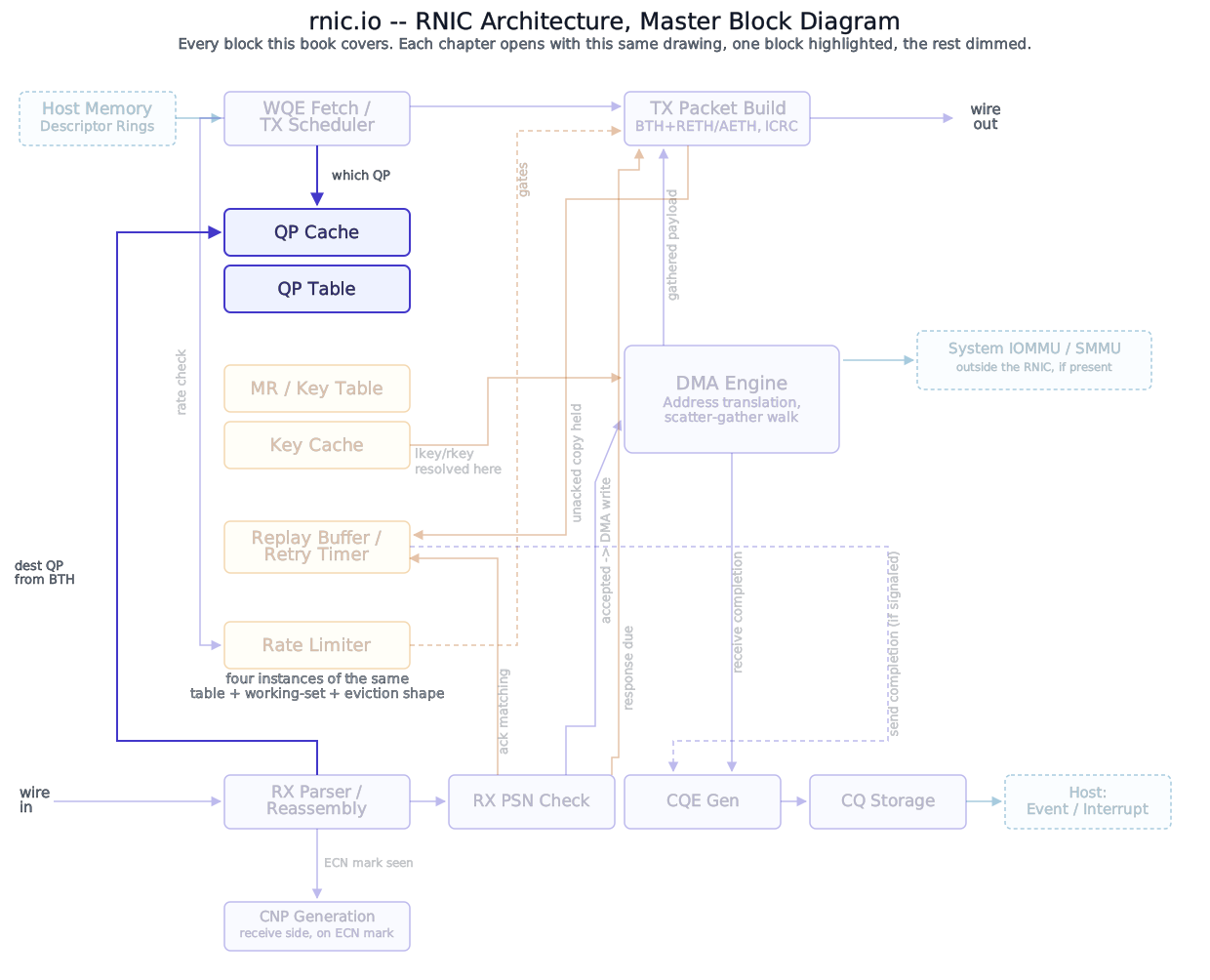
Block diagram
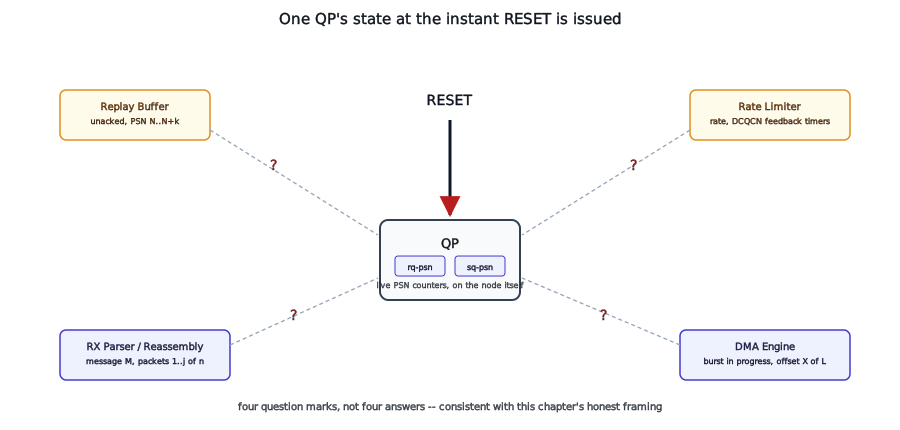
Deep walkthrough
What actually exists to reconcile. A QP mid-transaction is never just “a state enum plus two PSN counters” – by the time RESET can be issued against it, RTS has let it accumulate real state elsewhere in the adapter, all of it this book has already named in earlier chapters: unacknowledged sent packets held in the reliability engine’s replay buffer, waiting on an ACK that RESET makes moot (Reliability Engine); a partially-arrived multi-packet message sitting in RX reassembly state, if the last thing this QP received was a FIRST or MIDDLE packet rather than a LAST (RX Pipeline); a DMA write that may be actively mid-burst into host memory this instant, not yet committed in full (DMA Engine); the live receive-side and send-side PSN counters QP Context already covered; and this QP’s live congestion/rate-limiter state – current injection rate, outstanding DCQCN feedback timers – which Congestion Control Engine owns and which is built the same table-plus-working-set-plus-eviction way the Replay Buffer is. RESET’s job is to leave none of that in a state that corrupts this same QP once it’s rearmed through INIT→RTR→RTS again.
Gotcha
Don’t conflate this QP rearming itself (ERROR→RESET, same QP object) with The QP Table’s ABA-shaped concern about a different, unrelated QP later reusing this same table entry after this QP is destroyed outright. Same table entry, two different hazards.
But the specific sequencing that gets there – what gets aborted, what gets allowed to finish, what gets silently dropped – is not something any public source for a real RNIC documents, for any of these five, rate-limiter state included.
Where this is checked, and why that’s an honest non-answer here. For every other chapter in this part, “where checked” points at a real pipeline stage: a table lookup, a comparison against a live counter, a validation gate. For mid-transaction reset, the honest answer is that this book cannot point at a specific stage and say “this is where the teardown sequencing happens,” because no vendor has published that sequencing. What can be said with confidence is what has to be true when RESET completes: the QP must not still be consuming replay-buffer capacity for packets nobody will ever retransmit again, RX reassembly state for an abandoned message must not leak into this same QP’s next incarnation once it’s rearmed, and a DMA write must not be left in a state where its completion status is ambiguous once RESET has completed.
When it fails. There is no “failure mode” to report here in the sense the rest of this part uses that phrase – RESET is defined to succeed unconditionally from any state. The risk this chapter is actually naming is a correctness risk, not a rejected transition: if a mid-burst DMA write is allowed to keep writing after the QP that issued it has already moved to RESET and been reassigned, or if replay-buffer capacity isn’t actually reclaimed until some later, unspecified point, that’s a bug class this book can point at without being able to say how any specific implementation avoids it.
What happens next. Once RESET completes and the QP re-enters INIT, it starts the same hardware-enforced sequence QP State Machine already covered, as if built fresh – nothing about mid-transaction reset changes that forward path. The open question this chapter leaves is entirely about what happened to the state that used to belong to this QP’s previous incarnation on the way there.
Why
Three real design questions sit inside “clear the leftovers,” and a real implementation has to answer all three, even though none of them is settled in anything this book found public. First: does a DMA write already in progress get allowed to run to completion, or aborted mid-burst? Letting it finish is simpler and avoids a torn, half-written destination buffer, but only if nothing downstream is watching for the operation’s completion status anymore – and something might be, if completion reporting (Completion Queue / Event Management) hasn’t itself been told the QP is gone. Aborting mid-burst avoids that ambiguity but risks leaving the destination in a state no future reader of that buffer was told to expect, which is arguably worse if anything assumed atomicity at the message boundary. Second: does the replay buffer’s unacked data get force-freed the instant RESET is issued, or held until its retry timer would naturally have expired? Force-freeing reclaims capacity immediately, which matters under the same cache/working-set pressure Queue Pair Management’s QP Caching and Eviction Policy chapters already established is real; holding it costs nothing except capacity for something that’s provably never going to be used again, since RESET has already decided this QP’s sequencing state is void. Third: what happens if RESET is issued in the exact window where a retry retransmission has already left the TX pipeline for this QP but hasn’t yet reached the wire – does that packet still go out, referencing a QP context that’s already been reset underneath it? Each of these is a real race a real implementation has had to resolve one way or another; this book states the questions with confidence and declines to guess at any vendor’s specific answer. The replay-buffer and retry-timer questions are taken up again in Mid-Transaction Reliability Reset, which resolves both.
Food for Thought
Pick one of the three races above – DMA-write-in-progress, replay-buffer force-free timing, or a retransmission already in flight when RESET lands – and argue both sides. What would you actually build, and what would you give up either way?
This is not a new class of problem. chipdv.io’s Mid-Sim Reset covers the same shape of hazard – a resource torn down while something is still actively using it – from a testbench-verification angle: a reset arriving mid-simulation while a driver, monitor, or sequence still holds state that assumes the DUT hasn’t moved. The domain is different, but the question underneath it isn’t: what does “reset” actually have to reconcile when it doesn’t arrive at a quiet moment.
This is the last chapter in this part built around one QP at a time. QP Capacity and Timing, next, closes Queue Pair Management by asking how many of these can exist together, and what it costs in silicon to let them.
References
- InfiniBand Trade Association, InfiniBand™ Architecture Specification, Volume 1 (General Specifications).
- No IETF or IBTA standard governs the exact hardware sequencing of a mid-transaction reset (as opposed to the RESET state transition itself, which IBTA-V1 does define) – it is implementation-specific silicon design, not a wire-format or software-interface contract any standards body defines. This chapter’s treatment is grounded in the sources cited in-text above, not a standards document.