Installing a QP
Overview
A QP doesn’t arrive in hardware fully formed. IBTA-V1 requires only that a QP come into existence as an allocated, addressable, and inert resource – a table entry with a QP number, present but not yet configured with anything a packet could use – before the one gated transition, RESET→INIT, gives it a port and a fixed remote-access permission set. Nothing in the standard says how many QPs one allocation request produces, or what the allocation path looks like in silicon; that’s an architectural degree of freedom, not a wire-format or verbs-API fact, and this chapter opens with it before naming any specific software call. Installing a QP is the combination of that allocation and RESET→INIT. Everything past INIT – naming a peer, arming the QP to send – is QP State Machine’s subject; this chapter stops at the first gate.
Locator
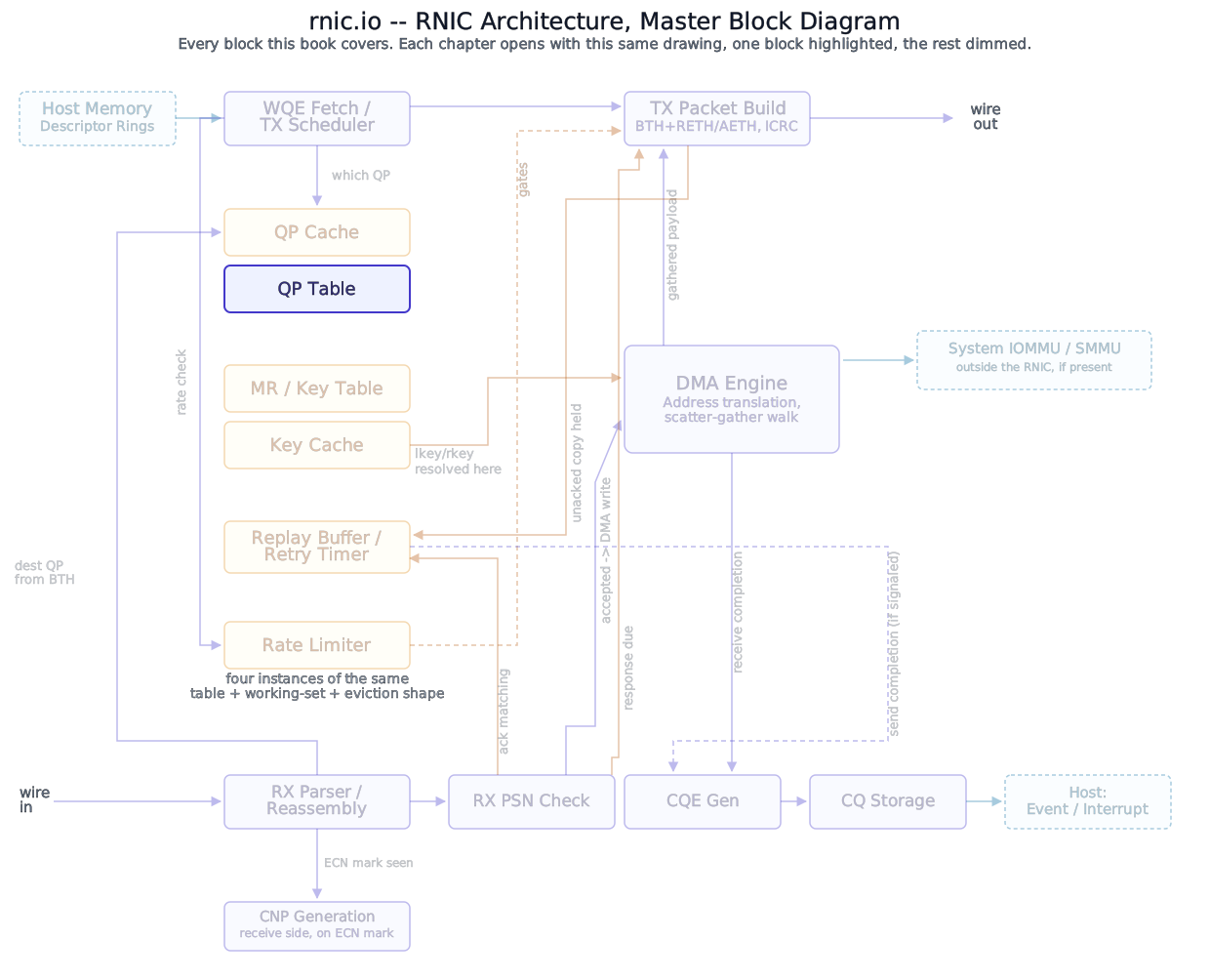
The QP Table covered the structure a QP’s context lives in once it exists. This chapter covers how it gets there in the first place.
Block diagram
Deep walkthrough
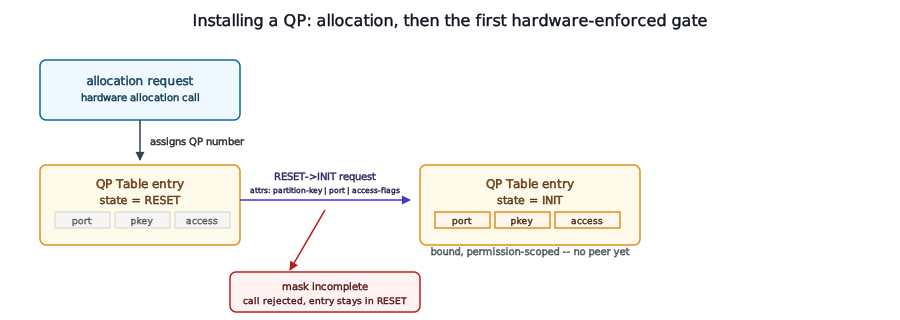
Allocation: the entry exists before it means anything. Creating a QP is a resource-allocation event against The QP Table’s indexing scheme: some entity assigns a QP number and marks the corresponding entry present and addressable in the RESET state, carrying no port binding, no access permissions, no peer. That’s the entire allocation-time requirement IBTA-V1 places on the architecture. How many QP numbers one allocation request actually produces is a question the standard leaves open, not one it answers – an adapter could just as reasonably grant exactly one QP number per request as it could grant a batch of them in a single allocation call, amortizing whatever fixed per-request overhead the allocation path carries (a command descriptor, a doorbell ring, a firmware round trip) across many QPs a workload knows up front it’s about to need, an MPI job or a distributed-training job establishing dozens of peer connections at startup being the obvious case. Nothing in the public record documents a shipping RNIC doing the latter, and this book doesn’t assert one does; the point is that “one QP per allocation” is a plausible software-interface convention, not an architectural ceiling – the dominant software model for requesting a QP asks for exactly one per call, but that’s a fact about a software contract, not evidence that the hardware resource allocator underneath it is incapable of granting more than one QP at a time. A QP in RESET cannot legally send or receive anything; RESET exists specifically to hold a QP that’s been allocated but not yet configured, and it’s also the state a QP returns to when it’s later torn down and rebuilt (per QP State Machine’s ERROR→RESET path).
RESET→INIT: the first thing hardware actually enforces. This is the QP’s first state-transition request, and IBTA-V1 itself specifies exactly which attributes a Reliable Connection QP must supply at this transition – the requirement is the standard’s own state-machine definition. For RC, that’s exactly four attributes: the state target itself, the partition-key index attribute, the port-binding attribute, and the remote-access permission mask. Each does specific, necessary work:
- The port-binding attribute places the QP on one of the adapter’s physical ports – which wire this QP’s traffic will actually go out and come in on. A QP has to belong to exactly one port before it can be associated with any path to a peer.
- The partition-key index attribute selects which partition key this QP presents – on native InfiniBand, where a subnet manager actively assigns and enforces partitions, this is a live access-control boundary checked well before any specific peer is named. This book is about RoCEv2 specifically, and RoCEv2 has no subnet manager: there’s no fabric-wide authority assigning non-default partitions, so in practice almost every RoCEv2 deployment runs every QP against the default, full-membership P_Key. The field is still required here – the wire format carries it, or the RC opcode catalog’s BTH (What Is RoCEv2) wouldn’t have anywhere to put it – but treat it as present for spec-compatibility with the field’s IB origins, not as an active partitioning mechanism doing real access-control work in a typical RoCEv2 fabric.
- The remote-access permission mask fixes, up front, which remote operations this QP will honor against it once it’s live: remote write, remote read, remote atomic, each independently enable-able. RESET→INIT is where this must first be supplied – a QP is never allowed to exist in a state where its permission set is merely undefined – but it isn’t frozen there for the QP’s whole life. Unlike the port-binding and partition-key attributes, it can be resupplied later: a same-state RTS→RTS transition that changes access flags on an already-live QP without touching the state target at all. A QP that wasn’t granted remote-write access at INIT can be granted it later, live, in RTS; it’s the port-binding and partition-key attributes – not eligible for that same live update – that can’t be changed without tearing the QP down.
Supply all four and the QP moves to INIT. Supply fewer, and per QP State Machine’s general rule for every transition in this book, hardware refuses the call outright – the entry stays in RESET, unchanged, not partially updated with whichever attributes did arrive.
Gotcha
There’s no state where a QP is “half-installed” with a port but no access flags. Either the whole mask is satisfied, or none of it takes effect – a rejected call never leaves partial attributes in place.
What INIT still doesn’t have. A QP in INIT has a port and a permission set, but no peer – no destination-QP field set, no path, no starting PSN. It cannot yet send or usefully receive; the next transition, INIT→RTR, is what actually connects it to somebody, and that transition, along with everything RTR→RTS adds on top, belongs entirely to QP State Machine. This chapter’s installation step ends here, deliberately: RESET→INIT is about making a QP a bound, permission-scoped object on the fabric; INIT→RTR and beyond are about connecting that object to a specific peer.
Everything else that has to exist around it. A QP doesn’t get installed in isolation – One Transaction, Start to Finish already walked the fuller bring-up sequence this step sits inside: a Protection Domain, at least one registered Memory Region, and a Completion Queue typically all exist before or alongside QP creation, since a QP needs a PD to belong to and a CQ to report completions into before it’s much use. None of that is re-derived here – this chapter’s scope is the QP’s own installation step, not the objects around it.
Why
Requiring the remote-access permission mask at RESET→INIT rather than leaving it unset until some later, optional call closes off a real gap: without that requirement, a QP could reach a state where it’s capable of exchanging packets while its permission set is simply undefined, which is exactly the kind of ambiguity a hardware-enforced gate exists to prevent. But unlike the port-binding and partition-key attributes – which really do need a full teardown to change, since they have no equivalent live-update path at all – access flags get a second, live path precisely because permission changes are a normal, expected operational need (granting remote-write access to a connection that didn’t start with it, say) in a way that changing a QP’s physical port or partition membership mid-connection isn’t. The design didn’t pick uniform rigidity across every RESET→INIT attribute; it picked rigidity for the two that define what a QP structurally is, and left a live door open for the one that’s routinely operational.
That’s every bit RESET→INIT requires, and nothing named above is optional – omit one and the call is refused, per QP State Machine, which picks up immediately where this chapter stops: INIT→RTR, naming a peer, and RTR→RTS, arming the QP to send.
References
- InfiniBand Trade Association, InfiniBand™ Architecture Specification, Volume 1 (General Specifications).