Ordering and Outstanding-DMA Tracking
Overview
Two independent questions share this chapter because they’re both, at heart, about what a QP is entitled to assume while this engine is working on its behalf. The first is a standard-defined guarantee, precise but narrower than it sounds: what order does a QP’s own requests execute in, and what does a completion actually promise about data having landed. The second has no standard at all: how many transfers can this engine actually run at once, across every QP calling into it, and what happens to the QP that finds that capacity already spoken for.
Locator
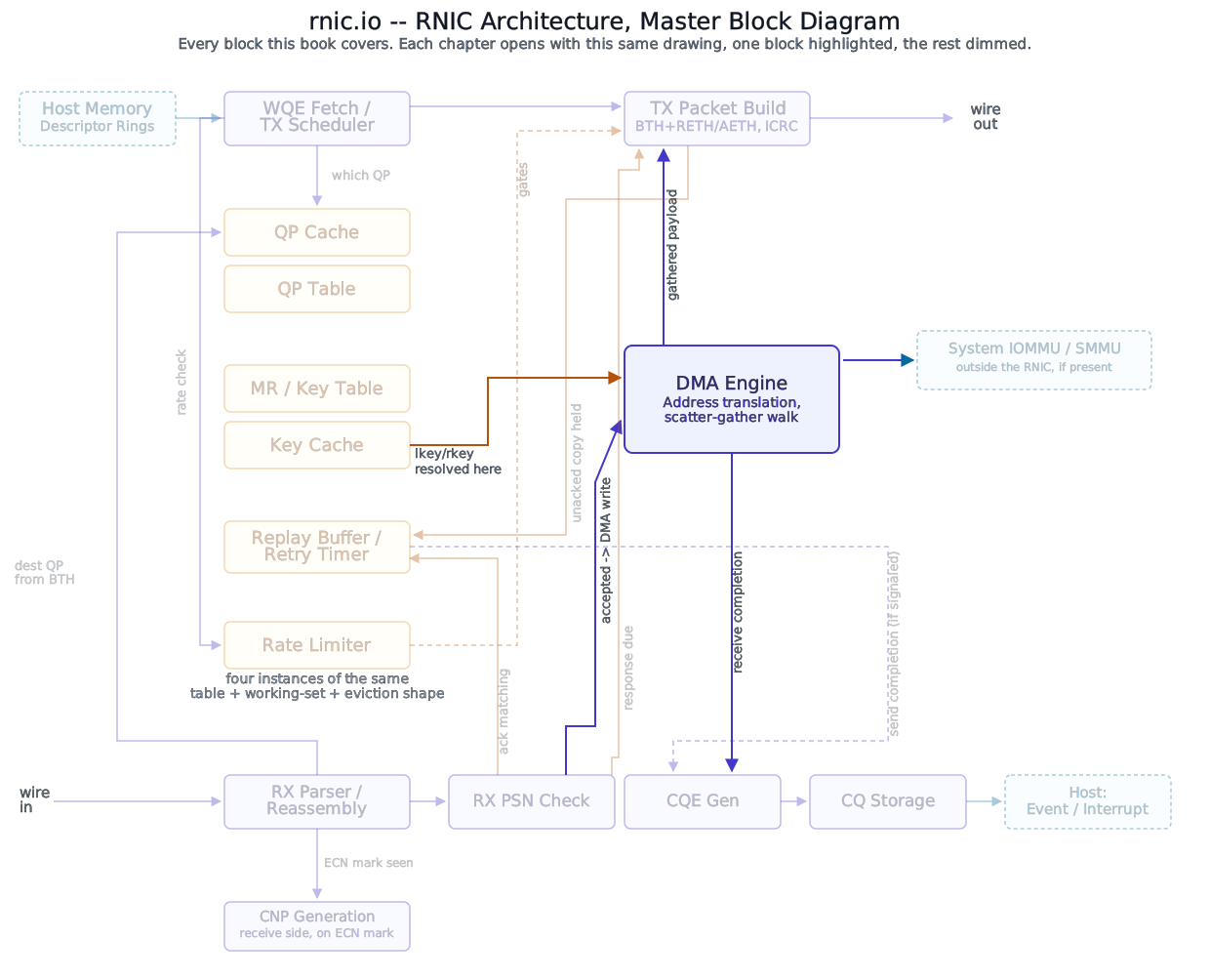
Block diagram
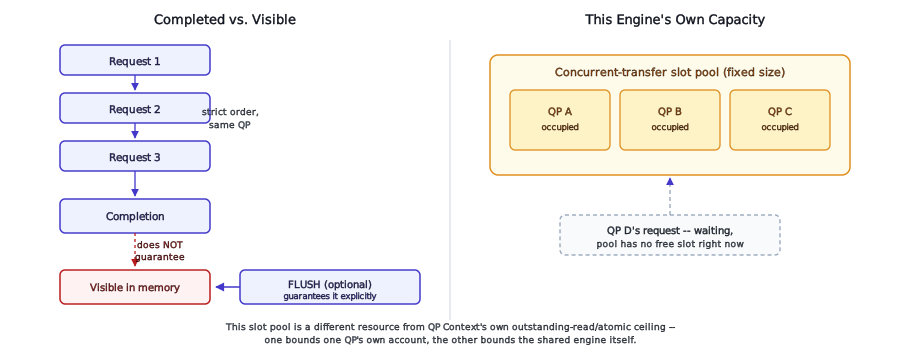
Deep walkthrough
What IBTA actually guarantees for a Reliable Connection: in-order execution, not immediate visibility. A QP’s own posted requests execute in the order they were posted, and a signaled completion implicitly confirms every request ahead of it in that same order has also completed – the same cumulative guarantee Go-Back-N Retransmission already relies on for its own retry logic. That’s a real, standard-backed guarantee about sequence. It says nothing, on its own, about visibility – whether a write’s bytes have actually reached memory in a form a subsequent, unrelated read of that same location would observe.
Gotcha
“My completion fired, so my data is in memory” is a weaker claim than it sounds like. A completion for a WRITE or a SEND confirms the responder’s reliability engine acknowledged the transfer – it does not, by itself, confirm this engine’s own scatter has finished landing bytes in the memory hierarchy behind that acknowledgement. Fast, posted writes into a memory subsystem can be absorbed into a buffer that accepts responsibility for placement, while reporting success to whatever asked immediately.
Real enough a gap that IBTA built a fix for it. IBTA’s own Memory Placement Extensions (Volume 1, Release 1.5) added a new operation, FLUSH, for exactly this reason: it executes like an RDMA Read – ordered, flow-controlled, acknowledged – and guarantees that every prior write on that connection has actually become visible to the responder before FLUSH’s own completion reaches the requester. An application with no durability requirement beyond ordinary completion semantics has no reason to reach for it; one that needs to know bytes are actually placed – persistent-memory writes being the motivating case – issues a FLUSH specifically because ordinary completion doesn’t promise that on its own.
Concept
Treat “completed” and “visible” as two separate claims about a write, not two words for the same fact. Ordinary completion promises the first. Only FLUSH promises the second.
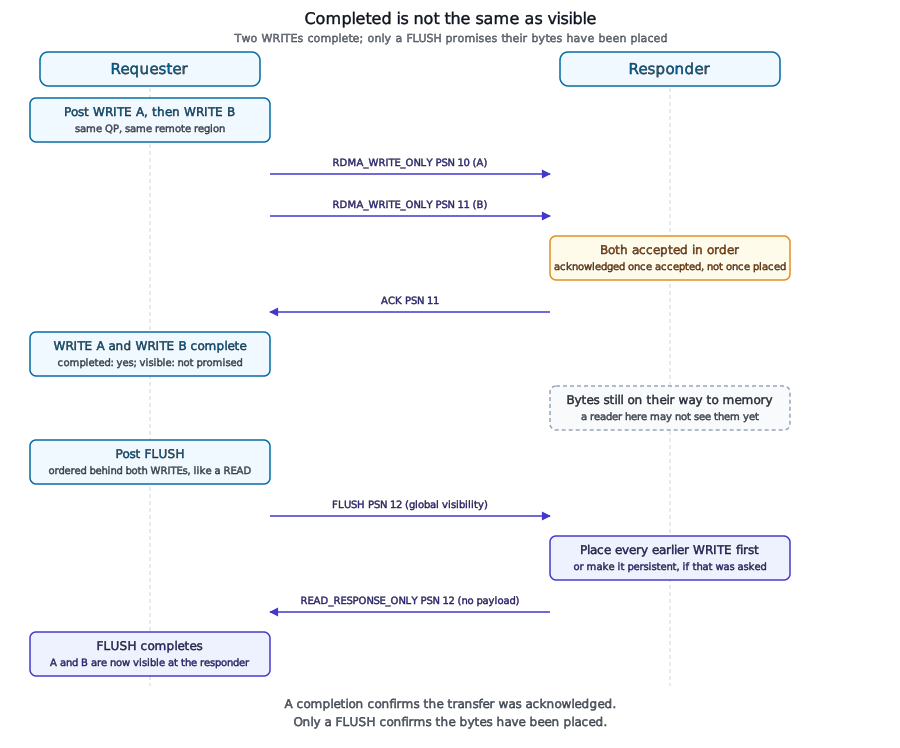
All 11 steps
- The application posts two RDMA WRITEs to the same remote region on one QP. Ordering and Outstanding-DMA Tracking
- Both WRITEs go out back to back; the second doesn’t wait for the first to be acknowledged. Ordering and Outstanding-DMA Tracking
- The responder accepts both, in order. A memory subsystem can take responsibility for posted writes before their bytes are placed. Ordering and Outstanding-DMA Tracking
- One cumulative ACK for PSN 11 covers both WRITEs. Ordering and Outstanding-DMA Tracking
- Both WRITEs complete at the requester. Completion confirms they were acknowledged in order. Ordering and Outstanding-DMA Tracking
- No. Ordinary completion promises order and acknowledgment, not placement. The bytes may still be on their way into memory. Ordering and Outstanding-DMA Tracking
- To get that promise the application posts a FLUSH. It is ordered behind both WRITEs and handled like a READ: it waits for a response. Ordering and Outstanding-DMA Tracking
- The FLUSH asks for global visibility. The other placement type it can ask for is persistence, for persistent memory. Ordering and Outstanding-DMA Tracking
- Before answering, the responder makes every earlier WRITE on the connection visible. In rxe, the Linux software RoCE driver, that is a write barrier for visibility, or a flush of the persistent-memory range for persistence. Ordering and Outstanding-DMA Tracking
- The response is a READ response with no payload, so the FLUSH completes like a READ. Ordering and Outstanding-DMA Tracking
- The FLUSH completes. The application now knows what the earlier completions couldn’t tell it: A and B are visible at the responder. Ordering and Outstanding-DMA Tracking
An explicit ordering request between a Read and what follows it – already named, not re-derived here. The WQE and the Send Queue Descriptor already covers the mechanism that closes this exact gap: a fence request, carried as one of a Work Request’s own flags, “holds this Work Request’s own issue until every earlier RDMA read and atomic operation posted to the same Send Queue has completed” – RDMAmojo’s own documentation states the guarantee directly. That chapter’s interface table already calibrates the standard’s role precisely: “IBTA-V1 requires the ordering guarantee be expressible; this flag shape is architect’s choice.” This engine is simply what honors that flag once it reaches execution – without it, a plain SEND or WRITE posted right after a READ has no inherent reason to wait for that READ’s data to actually arrive, and this engine is free to run them concurrently. Single-QP Pipeline Stalls already covers what a fenced Work Request looks like from the stalled QP’s own side, if a reader wants that half of the picture too.
Outstanding read/atomic tracking already has an owner – and it isn’t this chapter. QP Context already covers a real, IBTA-defined pair of fields: a requester-side ceiling bounding how many RDMA reads and atomics this QP may have outstanding at once, and a responder-side ceiling bounding how many it will accept from its peer. That’s a per-QP negotiated attribute, set once at connection setup. It is not the resource this chapter’s second half is about.
Analogy
QP Context’s ceiling is like a credit limit – how much this one account is allowed to owe at once. This engine’s own concurrent-transfer capacity, below, is like the teller window itself – how many transactions the branch can physically process at the same moment, regardless of whose account any of them belong to. A QP well within its own credit limit can still be made to wait if every teller window is already busy serving someone else.
This engine’s own concurrent-transfer capacity – a real resource, with no standard describing it. However many transfers this engine’s hardware can actually execute at once is a fixed, implementation-specific capacity, shared across every QP that calls into it – the same shape of provisioning question as how many outstanding transactions a memory controller or a PCIe root port can track at once. In-Flight Transfer State is what one occupied slot in that capacity looks like; this chapter is about the size of the pool those slots come from, and what happens when every slot is already spoken for. Single-QP RX Stalls already named the symptom directly – “a DMA engine already occupied placing something else” – without describing the resource behind it. Multi-QP Burst Arbitration, immediately next, is what a QP’s own request actually experiences when it finds that pool full.
Gotcha
Don’t reach for QP Context’s outstanding-read/atomic ceiling to explain a stalled DMA. That ceiling only ever limits one QP’s own read/atomic pipeline depth against its own peer’s stated capacity – it says nothing about whether the shared engine executing an ordinary WRITE’s scatter, or a SEND’s gather, has a free slot to run it in right now.
Interface reference
| Question | Answer |
|---|---|
| Does a QP’s own requests execute in order | yes – IBTA-guaranteed for RC, cumulative completion semantics apply |
| Does a completion guarantee memory-hierarchy visibility | no – only FLUSH (IBTA Memory Placement Extensions) makes that guarantee explicitly |
| Does this engine wait for a prior Read before a later Send/Write by default | no, unless the request carries the fence flag (The WQE and the Send Queue Descriptor) |
| What bounds one QP’s own outstanding reads/atomics | QP Context’s requester-/responder-side ceiling pair – not this chapter’s resource |
| What bounds how many transfers this engine runs at once, across all QPs | an implementation-specific concurrent-transfer capacity – no standard defines it |
References
- InfiniBand Trade Association, InfiniBand™ Architecture Specification, Volume 1 – governs RC’s in-order execution and cumulative completion semantics.
- InfiniBand Trade Association, Memory Placement Extensions, Supplement to InfiniBand Architecture Specification Volume 1, Release 1.5 (2021) – introduces the FLUSH operation and its explicit prior-writes-visible-before-completion guarantee, the standard-level closing of the gap this chapter’s central Gotcha describes.