Single-QP Rate-State Faults
Overview
Every other chapter in this Part assumed correct operation: a real Congestion Notification Packet, correctly formed, arriving for a QP that exists and is still sending. This chapter asks what happens when either of those assumptions fails for exactly one QP – and finds that most of it isn’t a new problem this Part has to solve on its own.
Locator
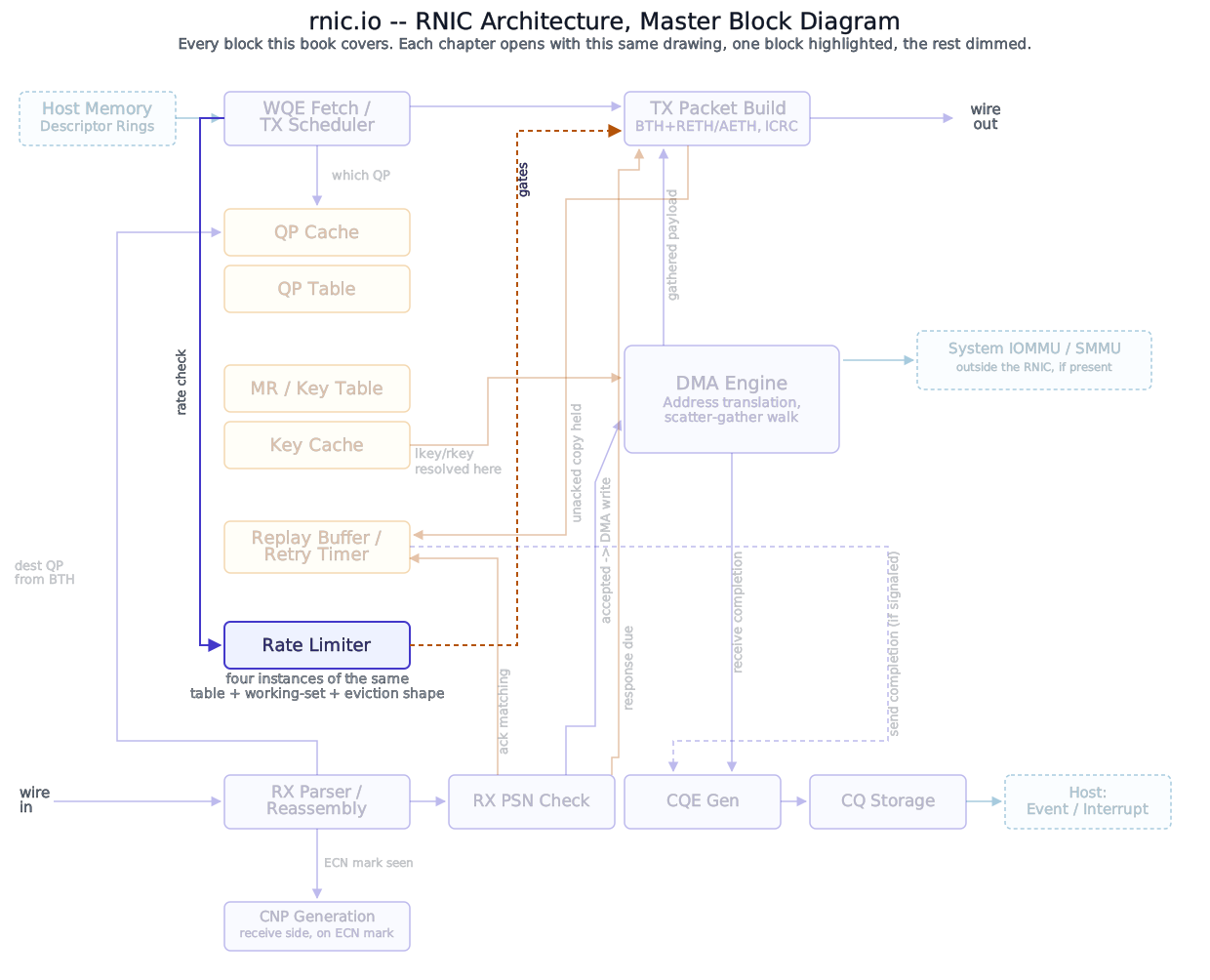
The Rate Control State Machine covered correct-case recovery. This chapter is what happens when a CNP isn’t correct, or the QP it targets isn’t in a state to use it.
Block diagram
Deep walkthrough
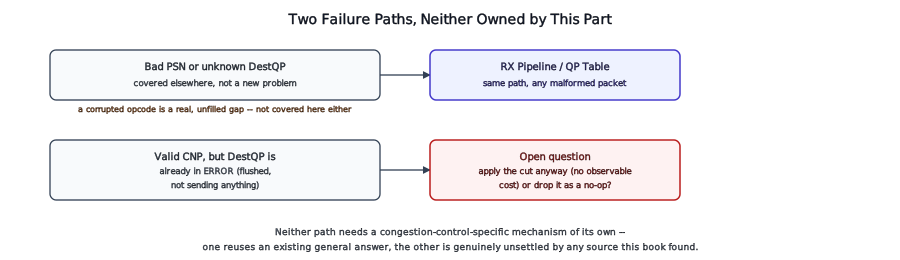
Most of a malformed CNP is not a new problem – it’s an old one, already solved. CNP Generation named CNP’s exact wire format: a specific opcode, a forced PSN of zero, a DestQP naming the flow being throttled. Two of the ways that shape can arrive violated already have a real, citable answer: an unexpected PSN and a DestQP that doesn’t correspond to any QP this adapter currently has allocated are exactly the failure modes RX Pipeline’s PSN-check stage and The QP Table’s unallocated-index handling already cover for any packet, CNP or otherwise. A corrupted or unrecognized opcode is narrower: this book’s own operation catalog doesn’t specify what happens to a packet carrying one, for a CNP or any other packet type – a real gap this chapter isn’t in a position to close on congestion control’s behalf, since it isn’t this Part’s mechanism to begin with.
Gotcha
Don’t go looking for a congestion-control-specific packet-validation chapter for the PSN and DestQP cases – there isn’t one, on purpose, since a general answer already exists and already covers them. The opcode case is different: it’s a genuine, unfilled gap in this book’s own RX-side coverage, not a congestion-control-specific one this chapter is declining to solve out of restraint.
A CNP for a real QP that’s already in ERROR – addressed, but with nothing left to protect. Single-QP Error Handling already established that a QP in ERROR flushes every queued Work Request and stops sending anything new at all. A CNP can still arrive naming that QP’s number – nothing about the wire or the sender knows the destination has faulted – and nothing about receiving it is itself invalid. But the rate limiter’s entire purpose is pacing future transmission, and a QP in ERROR has none coming. The CNP’s rate cut and reaction-factor update, if applied at all, would have no QP behavior left to actually pace.
Food for Thought
No source this book found says whether a real implementation bothers to apply the rate cut anyway, to a QP that’s already stopped sending, or simply drops a CNP addressed to a faulted QP as a cheap no-op. Both are defensible: applying it costs nothing observable and keeps the logic uniform; skipping it saves a write to state nothing will ever read again before the QP is destroyed or reset. Which would you build, and would your answer change if this rate-limiter entry might outlive the fault, waiting to be reused by a future QP at the same number?
What this chapter is not. It isn’t Mid-Transaction Rate-State Reset’s subject – that chapter, closing this Part, covers what happens to this state specifically when a QP transition (RESET, or destruction) is issued while rate-limiter state is live, the same shape Mid-Transaction QP Reset already asked of QP context generally. This chapter is narrower: a single QP’s rate-limiter entry encountering a fault condition while the QP itself is otherwise untouched by a reset or teardown request.
Where this connects. Both paths this chapter named terminate outside this Part: malformed-packet rejection is RX Pipeline’s general mechanism, and what ERROR does to a QP’s outstanding work at all is Single-QP Error Handling’s. This chapter’s own contribution is naming that neither needs a congestion-control-specific variant – what’s genuinely this Part’s own open question is the narrower one above: whether a rate cut addressed to an already-faulted QP is applied or discarded.
References
- No IETF or IBTA standard, and no source this book found, addresses malformed-CNP rejection or rate-cut handling for an already-faulted QP as congestion-control-specific concerns – this chapter’s position is that neither needs to be, reasoning by cross-reference to RX Pipeline’s and Single-QP Error Handling’s already-published, general mechanisms rather than a new citation.