Mid-Transaction Rate-State Reset
Overview
Mid-Transaction QP Reset named this Part’s own resource among the five kinds of live state a QP’s RESET has to reconcile, back when this Part had no chapters at all: “current injection rate, outstanding DCQCN feedback timers.” That chapter was explicit that no public source documents the specific sequencing for any of its five, rate-limiter state included. This closing chapter inherits that position rather than resolving it further than the sources actually support.
Locator
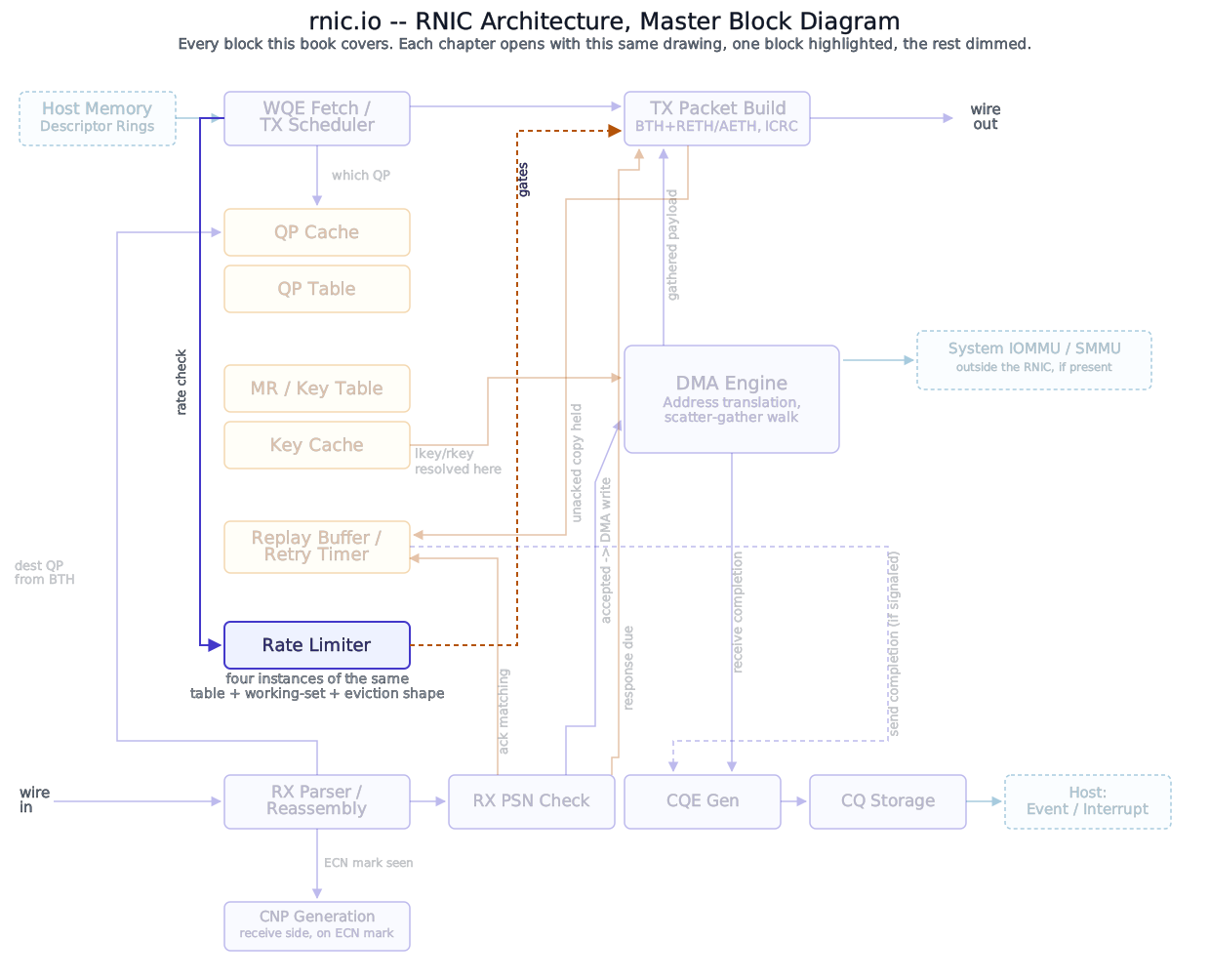
Eviction Policy covered what decides which entry leaves a working set, if one exists at all. This chapter is about what happens to an entry – cached or not – when the QP behind it is reset or destroyed while that entry is still live.
Block diagram
Deep walkthrough
What’s actually being asked, restated precisely. Mid-Transaction QP Reset already framed the general shape this chapter’s own version of the question takes: RESET is legal from RTS, with a QP’s operations actively in flight, and IBTA’s own contract for what RESET clears is thin. Applied to this Part’s own resource specifically: a rate cut can be underway – the reaction factor mid-update, the target rate just set from a freshly-arrived CNP – at the exact instant RESET lands. So can the recovery state machine The Rate Control State Machine covers, mid-phase, a fast-recovery or additive-increase step already begun but not yet committed.
Gotcha
This is not a hypothetical timing coincidence to wave away. A QP under active congestion is, by construction, one that’s recently received a CNP or is mid-recovery from one – exactly the QPs most likely to also be carrying other in-flight state RESET has to reconcile. A congested QP and a QP with a resettable race are not two independent populations; they overlap by construction.
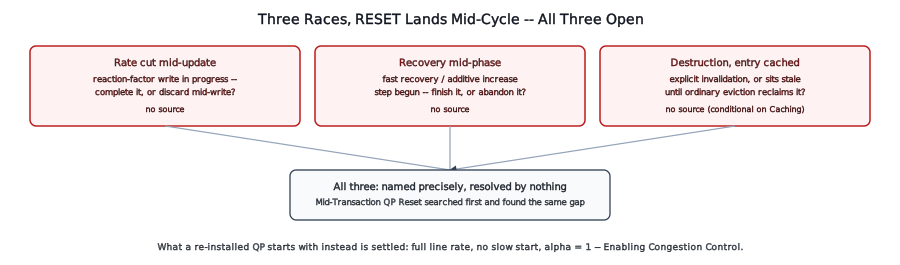
Three real races, stated as open rather than resolved. First: RESET issued while a rate cut is mid-update – does the reaction-factor write complete before RESET takes effect, or is it discarded in whatever state it was in? Second: RESET issued mid-recovery-phase – does the current fast-recovery or additive-increase step finish, or does RESET simply invalidate the whole state machine’s progress regardless of phase? Third, and structurally different from the first two: a QP destroyed (not merely reset) while its rate-limiter entry sits in an on-chip working set, if Caching’s open question resolves in favor of one existing at all – does destruction explicitly invalidate that cached entry, or does it sit stale, structurally the same hazard The QP Table already named for a freed-and-reissued QP number, until ordinary eviction pressure eventually reclaims it.
Food for Thought
Of the three races above, which would you expect a real implementation to actually get wrong first under test – and would your answer change between a QP that resets and reconnects quickly versus one whose number sits quarantined for a while before reuse, the same open question The QP Table already left unresolved for QP numbers generally?
Why this book doesn’t resolve these the way it resolved some of Completion Queue / Event Management’s own version of this question. Mid-Transaction CQ Reset had a real, direct citation to work with – IBTA-V1 §10.2.4.4’s documented recommendation for CQE draining before QP destruction. This chapter has no equivalent. Mid-Transaction QP Reset already searched for one, for this exact resource, before this Part existed, and came back empty. Nothing this Part’s own research turned up since changes that – the DCQCN paper and its cross-checked second implementation both describe steady-state algorithm behavior in detail, and neither says anything about a reset or destruction transition arriving mid-cycle.
What a freshly re-installed QP gets instead. Whatever this chapter can’t resolve about cleanup, Enabling Congestion Control already resolved for re-arming: a QP re-entering INIT and proceeding back through RTS gets the same fixed starting point any newly-installed QP does – full line rate, no slow start, reaction factor reset to 1. Whatever uncertainty this chapter leaves about how the old incarnation’s state was actually torn down, the new incarnation’s starting point is settled and sourced.
Where this leaves the Part. Mid-Transaction QP Reset’s own open question about this resource has a partial answer now, the same shape Mid-Transaction CQ Reset gave for its own resource: this chapter names the races precisely, confirms they remain genuinely unresolved by anything public, and refuses to manufacture a cleaner answer than the sources support. This Part closes here.
References
- No IETF or IBTA standard, and no source this book found – including the primary sources this Part draws on throughout – documents rate-limiter state’s behavior across a RESET or destruction transition. Mid-Transaction QP Reset already searched for this and found the same gap before this Part was written; this chapter confirms it remains a gap rather than re-searching from nothing.