Eviction Policy
Overview
Eviction Policy, Key Cache Eviction Policy, and Replay Buffer Capacity and Backpressure each opened from a confirmed premise: a real, sourced working set, under real, sourced pressure. Caching, this Part’s own version of that chapter, couldn’t offer the same premise – whether rate-limiter state needs a working-set cache at all is still open. This chapter covers what eviction would look like if it does, and folds in the hardware-versus-software question Hardware-Assisted Eviction Engines asks separately for its own resource, the same way Replay Buffer Capacity and Backpressure already combined both questions into one chapter for the Replay Buffer.
Locator
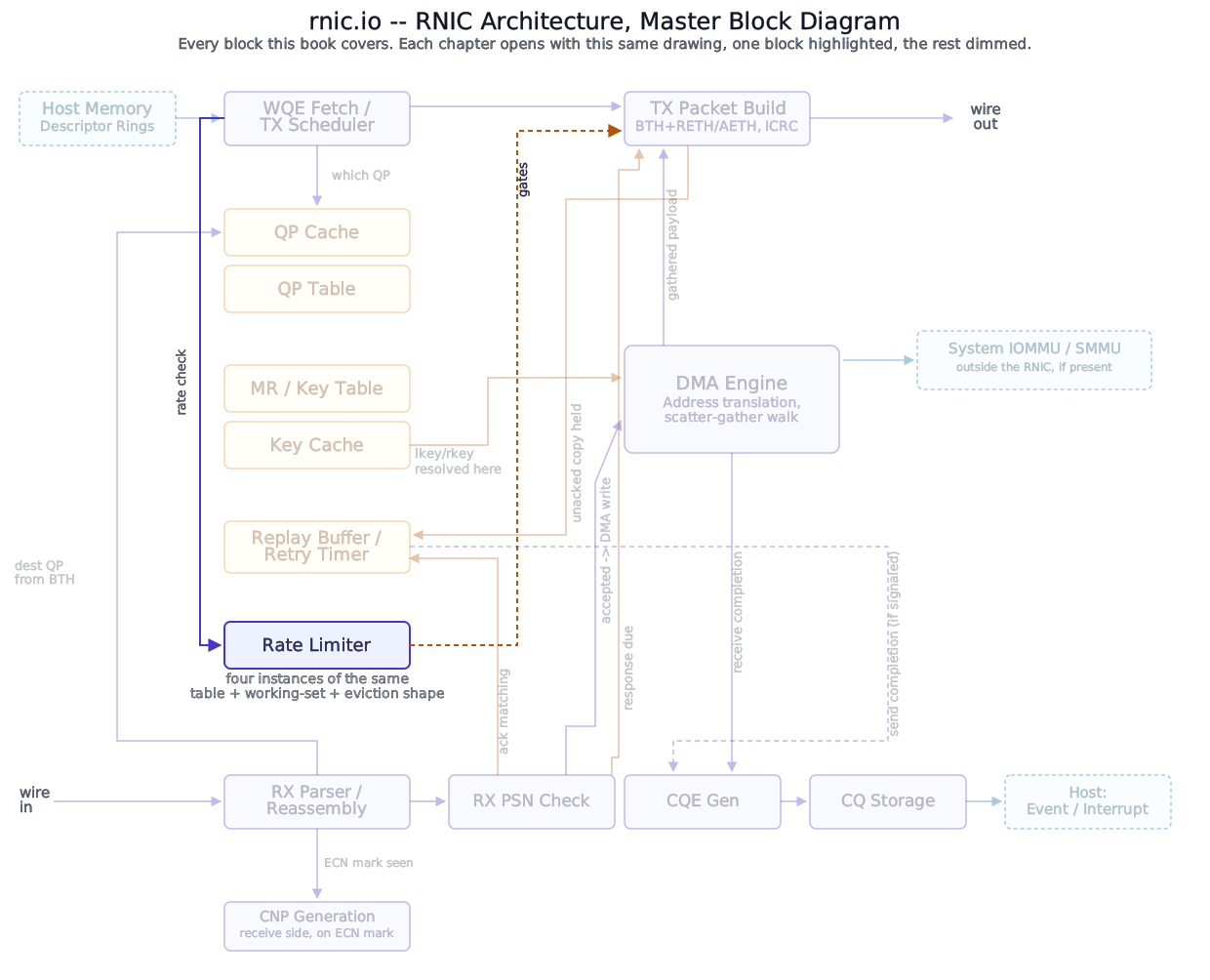
Caching left open whether an on-chip working set exists here at all. This chapter is what decides which entry leaves, if one ever has to.
Block diagram
Deep walkthrough
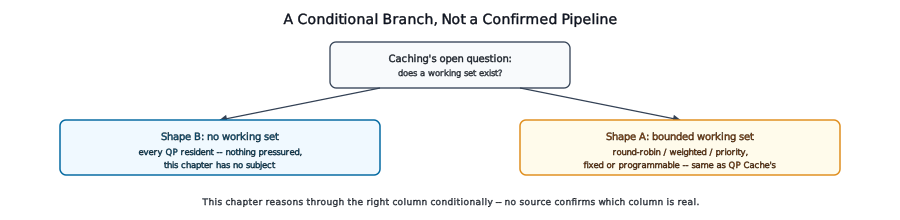
This chapter’s entire premise is conditional, and that has to be said plainly before anything else. Caching laid out two possibilities without a source to settle between them: either rate-limiter state is small enough for a real implementation to keep every QP’s entry resident on-chip permanently, in which case nothing is ever pressured and this chapter has no subject at all, or it needs the same working-set/backing-store split QP Caching and Key Caching already established for their own resources, in which case eviction is a real question with a real answer to give. Everything below assumes the second case, the same way Caching itself reasoned through it – clearly labeled as conditional, not restated as settled fact.
Gotcha
Don’t read the rest of this chapter as confirming that rate-limiter state gets evicted. It describes what eviction would look like, if Caching’s open question resolves the way QP Caching’s and Key Caching’s already did. No source this book found confirms it does.
If a working set exists, the same three candidates apply again. Eviction Policy already worked through the three shapes a real cache’s victim-selection logic can take: round-robin, blind to how urgently any one entry is needed; weighted round-robin, fixed by giving some entries priority at the cost of needing an external weight-owner; and strict priority, predictably fast for whatever’s marked most urgent, at a structural starvation risk for everything else. Nothing about rate-limiter state changes which of these three shapes is available – the same tradeoffs Eviction Policy already reasoned through for QP context apply unchanged here, if there’s a working set to apply them to at all.
Analogy
This is the same three-shape menu Multi-QP TX Scheduling and Event and Multi-CQ Arbitration both reused for their own, differently-shaped scheduling questions. Round-robin, weighted, priority isn’t a coincidence this book keeps rediscovering – it’s the same three answers to “who goes first, or who leaves first” recurring everywhere a shared resource has to be arbitrated or reclaimed, regardless of which resource it happens to be.
A rate-limiter-specific wrinkle, worth naming even conditionally: what does evicting this entry actually cost? Eviction Policy already established that evicting a QP context costs a future cache miss – a PCIe round trip, not a correctness problem, since the QP Table still holds the authoritative copy. The same would hold here, by the same reasoning The Rate Limiter Table already gave: this resource’s own backing store, if one exists, is the authoritative copy, so evicting a cached rate-limiter entry costs a refetch, not lost state. But refetching isn’t quite free of consequence the way a QP context refetch is: a rate limiter that’s momentarily lost its live current-rate and reaction-factor tracking has to resume from the refetched value, not recompute what it would have been had it stayed resident – a QP evicted mid-recovery and later reinstated resumes wherever its last-written state left off, potentially stale relative to how long it was actually away.
Food for Thought
If eviction does apply here, a rate-limiter entry that’s evicted and later reinstated resumes from a possibly-stale rate rather than one reflecting how much time has actually passed. Would you treat that staleness as harmless – the next CNP or recovery cycle corrects it soon enough – or would you want eviction policy for this specific resource to weigh recency differently than it does for QP context, where no such staleness exists?
Hardware-assisted or software-driven – the same question, folded in rather than split out. Hardware-Assisted Eviction Engines asked, for QP context, whether victim selection runs as fixed silicon, a programmable engine, or a software trap – and found real, dated evidence that at least one shipped RNIC sits at the software-driven end of that spectrum. Nothing about rate-limiter state changes that question’s shape, and this Part doesn’t have independent evidence pointing to a different answer for this specific resource – so this chapter folds the question in rather than manufacturing a second chapter’s worth of content where the honest answer is “the same open question, unresolved here too.”
Where this connects. Whether any of this chapter actually applies depends entirely on Caching’s own open question. What happens to this state – evicted or resident, cached or not – when the QP itself is reset or destroyed mid-transaction is Mid-Transaction Rate-State Reset, closing this Part.
References
- No IETF or IBTA standard, and no source this book found, confirms rate-limiter state has an eviction policy at all – this chapter’s content is conditional on Caching’s own open question, reasoning by analogy to Eviction Policy and Hardware-Assisted Eviction Engines’s already-sourced treatment of QP context, not a new citation for this resource specifically.