Caching
Overview
Key Caching named a real, sourced finding that QP context, memory-region translations, Completion Queue context, and Event Queue context all share one on-chip SRAM pool. No source this book found extends that finding to rate-limiter state. This chapter reasons through whether the same caching relationship – a small on-chip working set sitting in front of a larger backing store – actually applies here, and reaches a more qualified answer than any of this book’s other caching chapters have needed to give.
Gotcha
This chapter is not a fourth confirmed instance of Key Caching’s finding. Read every claim below as this book’s own reasoning, clearly labeled where it is, not as an extension of a citation that doesn’t cover this resource.
Locator
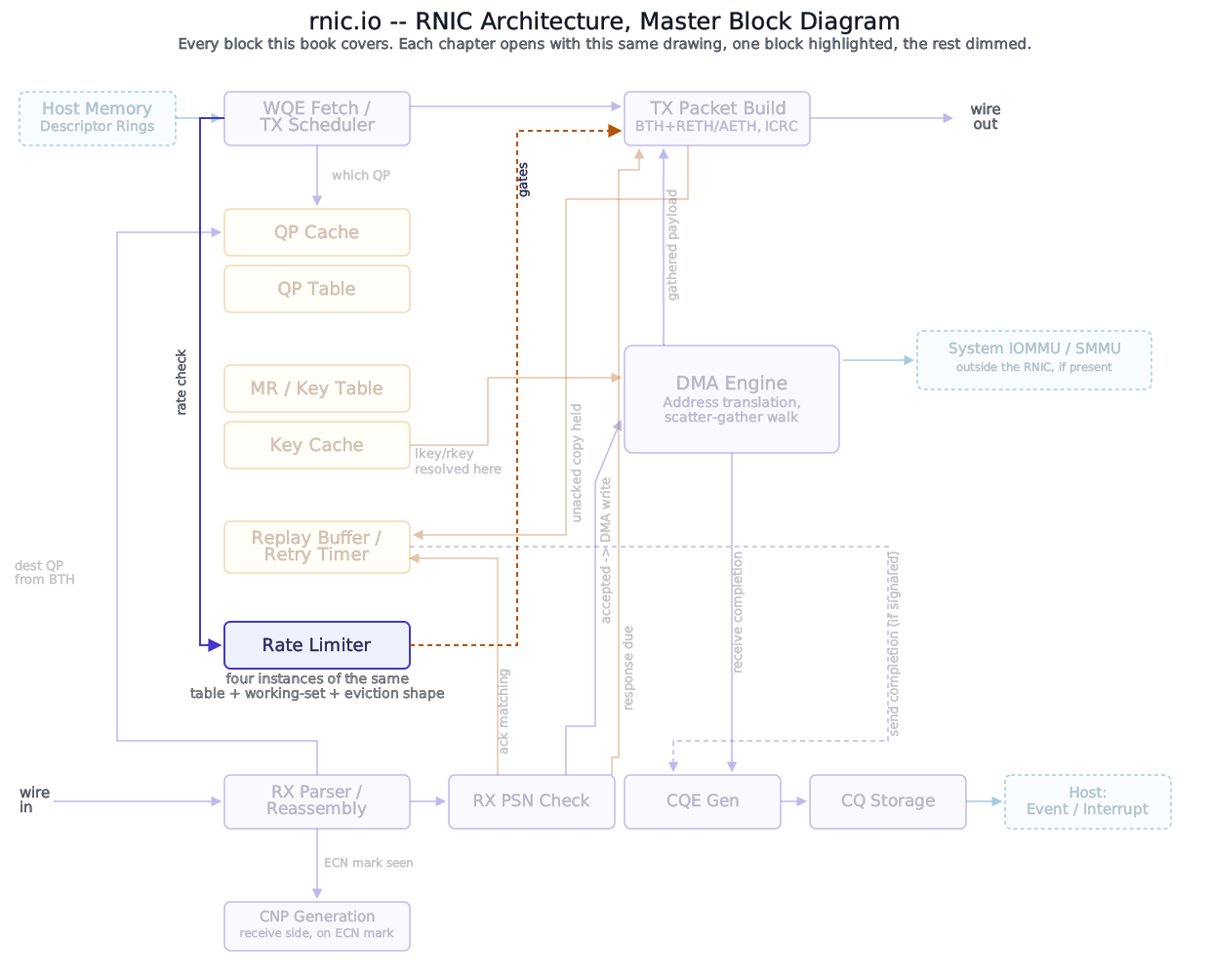
The Rate Limiter Table covered the storage structure and its addressing. This chapter is about whether that structure needs a cache in front of it at all.
Block diagram
Deep walkthrough
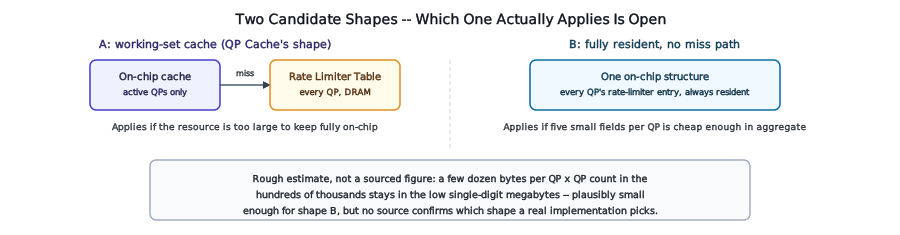
Why this question even needs asking, when the answer to “does congestion control need caching” might just be no. QP Context is rich enough, and Key Caching’s memory-translation entries numerous enough, that neither could plausibly stay resident on-chip for every QP or every registered region an adapter supports – that’s exactly the gap a working-set cache exists to bound. Rate-Limiter Context is a different shape: five small fields – two rates, one reaction factor, and a timer and a byte counter that each carry their own stage count – per QP, not per operation and not per registered memory region. A rough estimate, not a sourced figure: a few dozen bytes per QP, which stays in the low single-digit megabytes even at QP counts in the hundreds of thousands. Whether that’s small enough for a real implementation to keep entirely on-chip, for every QP it supports, with no working-set/backing-store split at all, is a real open question this chapter can reason about but not settle.
Why
A resource this small changes the caching tradeoff, if not the underlying instinct. QP Caching’s own Why callout already named the real tension: how much scarce on-chip SRAM to spend on one structure versus every other structure competing for the same die area. That tension is sharpest when a resource is large enough that “cache everything” is obviously wasteful. Five small fields per QP may simply not be large enough to make that tradeoff bite the same way – which would mean the honest answer to “what’s this resource’s eviction policy” is closer to there may not be one, not because this book is declining to look, but because the resource this Part has actually described may not need one.
If it does need a working-set/backing-store split, the shape is the familiar one. Should a real implementation’s rate-limiter entry turn out to be larger than this chapter’s estimate, or should on-chip SRAM budget be tighter than assumed here, the caching relationship would look exactly like QP Caching’s and Key Caching’s: a small on-chip working set of actively-touched QPs’ rate-limiter entries, backed by The Rate Limiter Table’s full, DRAM-resident population, with a miss costing the same PCIe round trip either of those two chapters already describe.
Analogy
This is the same “maybe it just fits” question a CPU’s own architects face with small, per-thread control state – a handful of control registers might live in dedicated on-die storage for every hardware context a core supports, with no working-set question at all, while a much larger per-thread structure (a TLB’s own translation entries, a branch predictor’s history tables) has no choice but to be a bounded cache. Size, not category, is what decides which shape a given piece of state actually needs.
Where this connects. If a working set does exist, Eviction Policy, next, covers what happens when it’s full. If it doesn’t – if every QP’s rate-limiter entry really does stay resident on-chip for that QP’s whole life – then eviction, in the cache-miss sense this book has used everywhere else, has no subject to describe here at all, and that chapter’s job becomes naming why, rather than picking a policy.
Food for Thought
This chapter reasoned from a rough size estimate, not a measurement of any real chip. What would actually settle this question – and would you expect the answer to be the same for a NIC supporting a few thousand QPs as for one supporting hundreds of thousands?
References
- No source this book found describes Rate Limiter state’s on-chip working-set behavior, size, or eviction model directly – unlike Key Caching’s QPC/MTT-MPT/CQC/EQC finding, which explicitly does not extend to this resource. Every claim above is this book’s own reasoned estimate, flagged as such throughout, not a citation.
- Zhu, Eran, Firestone, Guo, Lipshteyn, Liron, Padhye, Raindel, Haj Yahia, Zhang, “Congestion Control for Large-Scale RDMA Deployments,” SIGCOMM 2015 – the field list this chapter’s size estimate is built from.